The Molecule That Measures Your Sleep Debt
Somewhere deep in the basal forebrain, right now, a simple purine molecule is counting how long you've been awake. Every neuron that fires, every thought you complete, every task your brain performs — all of it generates a molecular byproduct called adenosine. As this adenosine accumulates in the extracellular fluid surrounding your neurons, it progressively inhibits the brain's wake-promoting circuits and activates its sleep-inducing ones. The result, after 14–16 hours of wakefulness, is an overpowering drive to sleep that no amount of willpower can permanently override.
This system — adenosine as the biological clock of sleep pressure — is among the most conserved mechanisms in mammalian neurobiology. It operates continuously, relentlessly, and with a chemical precision that modern pharmacology has learned to temporarily circumvent but not replace. Understanding it is fundamental to understanding why caffeine works, why it fails, and what the consequences of that failure actually are.
Adenosine: The Neuroscience of Tiredness
Adenosine (adenine + ribose) is one of the four nucleoside building blocks of RNA, and in its triphosphate form (ATP), it is the universal cellular energy currency. When neurons fire action potentials, they consume ATP at enormous rates — a single neuron can fire hundreds of times per second during intense cognitive activity. As ATP is hydrolyzed to ADP and AMP to release energy, some of this ultimately degrades to adenosine, which is released into the synaptic cleft and extracellular space.
The brain expresses multiple adenosine receptor subtypes, but two are most relevant to sleep regulation:
- A1 receptors: Widely distributed throughout the cortex, hippocampus, thalamus, and brainstem. When activated by adenosine, A1 receptors inhibit excitatory neurotransmission (reducing glutamate and acetylcholine release), directly suppressing the firing of wake-promoting neurons. A1 activation in the basal forebrain is particularly critical for generating slow-wave sleep pressure.
- A2A receptors: Concentrated in the striatum and ventrolateral preoptic area (VLPO). A2A receptor activation directly stimulates the VLPO — the primary sleep-promoting nucleus — which then inhibits all major wake-promoting systems (locus coeruleus, dorsal raphe, tuberomammillary nucleus, lateral hypothalamus). A 2011 study by Lazarus and colleagues in Nature Neuroscience demonstrated that selective A2A receptor activation in the shell of the nucleus accumbens was sufficient to induce NREM sleep, confirming this circuit's sufficiency for sleep induction.
Over the course of 16 hours of typical wakefulness, basal forebrain adenosine concentration rises by approximately 40–60% above the resting level observed at sleep onset. This linear accumulation is the molecular basis of what Alexander Borbely called Process S — the homeostatic sleep pressure that builds with every hour of wakefulness.
The Two-Process Model: Process S and Process C
Borbely's two-process model, published in Human Neurobiology in 1982 and subsequently expanded with Achermann, remains the most influential theoretical framework in sleep science. The model proposes that sleep timing and architecture are controlled by two interacting but mechanistically independent processes.
Process S (Sleep Pressure) is the homeostatic process. It rises exponentially during wakefulness — driven primarily by adenosine — and falls during sleep, most rapidly during slow-wave sleep (N3). The steepness of the rising slope depends on sleep history: chronic sleep restriction (high accumulated adenosine debt) steepens the curve; prior extended sleep (well-cleared adenosine) flattens it. The level of Process S at sleep onset determines both how quickly you fall asleep and the intensity and duration of slow-wave sleep in the first cycle.
Process C (Circadian Process) is generated by the suprachiasmatic nucleus (SCN), the master circadian pacemaker located in the hypothalamus. The SCN receives direct light input from intrinsically photosensitive retinal ganglion cells (ipRGCs) via the retinohypothalamic tract. The circadian output generates an internal alerting signal — sometimes called the "wake maintenance zone" — that rises through the day, counteracting the rising sleepiness from Process S, and peaks in the early evening. This circadian wake drive then falls sharply 1–2 hours after habitual sleep onset, permitting Process S to dominate and drive sleep.
The interaction is elegant: the circadian clock generates an alerting signal that is opposed to, and slightly out of phase with, Process S. This design prevents homeostatic sleep pressure from causing microsleeps throughout the afternoon and concentrates sleep into a single consolidated nighttime period. Disrupting either process — through caffeine (artificially suppressing Process S) or irregular light exposure (disrupting Process C) — impairs the two-process interaction and fragments sleep.
Caffeine's Mechanism: A Molecular Impersonator
Caffeine (1,3,7-trimethylxanthine) works by exploiting the structural similarity between its xanthine core and adenosine's purine base. Both molecules compete for the same receptor binding sites — A1 and A2A — but with a critical difference: adenosine is an agonist (activates the receptor), while caffeine is a competitive antagonist (occupies the receptor without activating it, blocking adenosine's access).
At the serum concentrations achieved by typical coffee consumption (100–200mg = 1–2 cups), caffeine achieves 30–50% occupancy of cerebral A1 and A2A receptors. At this level of receptor blockade, the adenosine-mediated inhibition of arousal circuits is substantially reduced, and the subjective experience of sleepiness is markedly attenuated. The wake-promoting circuits of the ascending arousal system (locus coeruleus norepinephrine, dorsal raphe serotonin, lateral hypothalamic orexin/hypocretin) are no longer being tonically suppressed.
The indisputable limitation: caffeine does not affect adenosine synthesis or clearance. While caffeine occupies receptors, adenosine molecules continue to accumulate in the extracellular space, unable to signal but physically present. This creates a dose of "hidden" sleep pressure that is revealed when caffeine's receptor occupancy falls — a process driven by the CYP1A2-mediated hepatic metabolism of caffeine to its primary metabolite paraxanthine.
Caffeine Half-Life and the 2pm Rule
The half-life of caffeine in healthy adults ranges from 3 to 12 hours, with a mean of approximately 5–7 hours. Half-life represents the time for plasma caffeine concentration to fall by 50%. With a 6-hour half-life:
| Time of Consumption (200mg) | Remaining at 10pm | Remaining at 2am |
|---|---|---|
| 7am (morning coffee) | ~12mg (6%) | ~3mg (1.5%) |
| 12pm (lunch coffee) | ~50mg (25%) | ~12mg (6%) |
| 2pm (afternoon coffee) | ~100mg (50%) | ~25mg (12.5%) |
| 5pm (late afternoon) | ~170mg (85%) | ~70mg (35%) |
At 25–50mg, caffeine still achieves meaningful A1 receptor occupancy and measurably suppresses slow-wave sleep. This explains why Matthew Walker and other sleep researchers recommend no caffeine after noon for most adults. For slow metabolisers (CYP1A2 C allele carriers, approximately 45–50% of the population), the half-life stretches to 8–10+ hours, making even a noon cutoff inadequate.
Caffeine and Sleep Stages: The Slow-Wave Problem
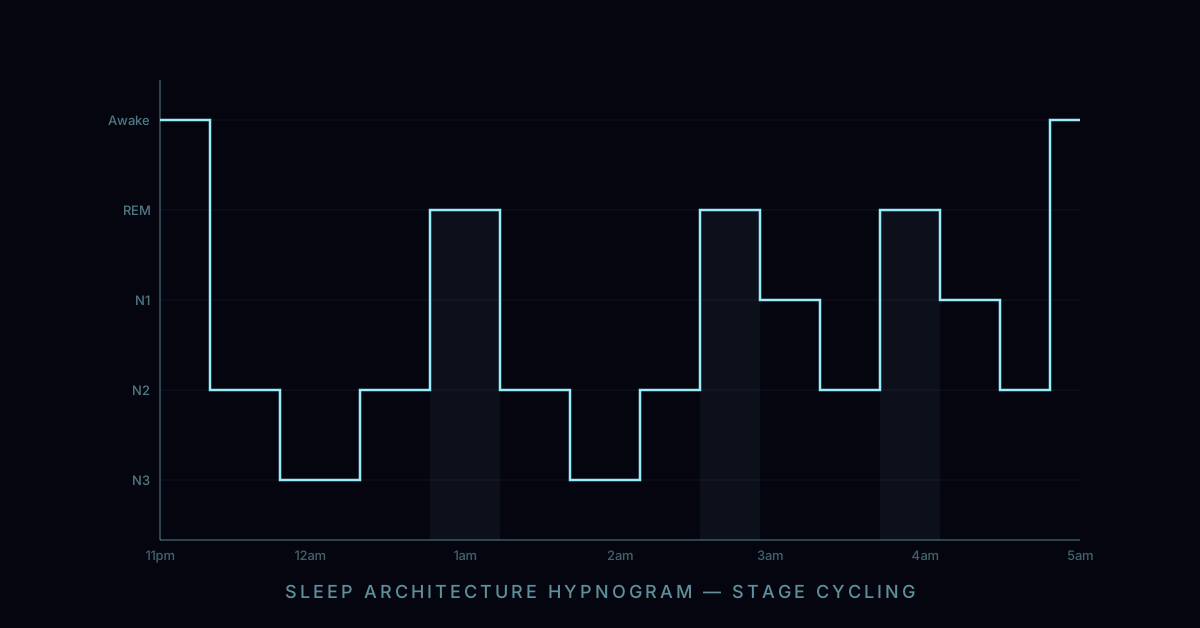
A consistent finding across polysomnographic studies is that caffeine suppresses slow-wave sleep (N3) even when consumed early enough not to prevent sleep onset or reduce total sleep time. The Landolt et al. 1995 study in Brain Research is the benchmark: 200mg of caffeine given at 7pm significantly reduced slow-wave sleep duration and slow-wave activity (0.5–4 Hz EEG power) in healthy adults who had no subjective sleep complaints.
The mechanism is direct: adenosine at A1 receptors is the primary driver of the homeostatic pressure that generates slow-wave sleep. When caffeine blocks A1 receptors during the pre-sleep period, the brain enters sleep with attenuated homeostatic drive — the molecular signal commanding deep sleep is muted. The result is lighter sleep architecture even when total sleep duration is preserved.
L-Theanine and the Caffeine Combination
L-theanine, a non-protein amino acid found primarily in green tea (Camellia sinensis), has a well-characterized synergistic relationship with caffeine that partially mitigates some of its disruptive properties. L-theanine promotes alpha-wave activity in the brain (associated with relaxed alertness), reduces sympathetic nervous system activation, and modulates GABA and glutamate neurotransmission in ways that reduce caffeine-associated anxiety and jitteriness without blunting the cognitive benefits.
A series of studies by Owen and colleagues (Nutritional Neuroscience, 2008) and Giesbrecht and colleagues (Nutritional Neuroscience, 2010) demonstrated that the 2:1 L-theanine:caffeine combination (200mg L-theanine + 100mg caffeine) produced greater sustained attention, faster reaction time, and improved working memory compared to either compound alone, with reduced self-reported anxiety. L-theanine does not, however, alter caffeine's adenosine receptor binding or its half-life — the slow-wave suppression effect of late caffeine persists.
Adenosine and Exercise: The Post-Workout Sleepiness Mechanism
Vigorous exercise acutely increases adenosine production through several pathways: direct ATP hydrolysis in exercising muscles releases adenosine into circulation, and neuronal activity during exercise increases brain adenosine. This likely contributes to the post-exercise drowsiness that many athletes experience, particularly after high-intensity training. Interestingly, regular aerobic exercise does not simply increase adenosine drive continuously — instead, exercise appears to increase adenosine receptor sensitivity and upregulate A1 receptor expression in the basal forebrain, potentially explaining why regular exercisers tend to achieve more slow-wave sleep without proportionally more daytime sleepiness (Youngstedt, Sports Medicine, 2005).
The adenosine rebound from exercise makes morning training particularly effective for sleep quality: the acute adenosine spike from morning exercise is cleared during the day, and the downstream A1 receptor upregulation from regular training augments slow-wave pressure at night.
Practical Implications: Rebuilding Your Adenosine Relationship
For individuals using caffeine primarily to manage chronic sleep debt — rather than for acute, strategic performance demands — the following framework aligns with the mechanistic evidence:
- Establish a noon caffeine cutoff as the minimum intervention; consider a 10am cutoff if you are a slow metaboliser or consistently report poor sleep quality despite otherwise good sleep hygiene.
- Delay morning caffeine until 90–120 minutes after waking — morning cortisol peaks in the first 30–60 minutes post-waking and provides natural alertness. Consuming caffeine during this cortisol peak blunts its effectiveness and promotes tolerance development.
- Eliminate caffeine for 2 weeks periodically to reset receptor sensitivity and accurately assess your baseline sleep quality without pharmacological masking.
- Track slow-wave sleep using a wearable before and after caffeine elimination — if deep sleep increases meaningfully, afternoon caffeine was suppressing it.
- Use caffeine as a tool, not a crutch — strategic use before acute performance demands is different from chronic use to compensate for insufficient sleep.
The central insight connecting all of these recommendations is that caffeine never reduces adenosine — it only delays the reckoning. When the drug clears, every molecule of adenosine that accumulated during caffeinated wakefulness will bind its receptor simultaneously, producing a crash whose depth is directly proportional to the hidden debt. This is why the "afternoon cutoff" rule is not a single universal time but an individualized calculation based on CYP1A2 genotype: fast metabolizers (half-life 3–4 hours) may tolerate a 2pm cutoff, while slow metabolizers (half-life 8–10 hours) need to stop by 10am to protect slow-wave sleep. Ultimately, the goal of adenosine management is not to perpetually block the signal but to support the conditions — adequate sleep duration, uninterrupted deep sleep, consistent wake times — under which adenosine clears naturally overnight, so that morning wakefulness requires no pharmacological assistance at all.