Quick Answer
The circadian rhythm is a self-sustaining ~24-hour molecular clock operating in virtually every cell of the body, driven by the CLOCK/BMAL1/PER/CRY transcription-translation feedback loop. It is reset daily by light via melanopsin-containing retinal cells projecting to the suprachiasmatic nucleus (SCN). It controls sleep, metabolism, hormones, immune function, and gene expression — up to 40% of all protein-coding genes oscillate in a circadian pattern. Disruption by artificial light, irregular sleep timing, or shift work is causally linked to metabolic disease, cancer, cardiovascular disease, and shortened lifespan.
What a Circadian Rhythm Actually Is
The word circadian comes from the Latin circa diem — approximately one day. A circadian rhythm is a biological oscillation with a period of roughly 24 hours that persists even in the complete absence of external time cues. This persistence is crucial: it distinguishes a circadian rhythm from a simple response to light and dark. Put a person in a windowless room with no clocks, no social contact, and constant dim lighting, and they will still cycle through sleep and waking, hunger and satiety, peak cognitive performance and fatigue, high and low core body temperature, on approximately a 24-hour schedule. The rhythm is endogenous — built into the biology, not imposed from outside.
The existence of biological timekeeping was known to naturalists for centuries — de Mairan observed in 1729 that a mimosa plant continued its daily leaf movements even in a dark cupboard — but the molecular mechanism was not elucidated until the 1990s and early 2000s. Jeffrey Hall, Michael Rosbash, and Michael Young received the 2017 Nobel Prize in Physiology or Medicine for their work identifying the molecular components of the clock in Drosophila — a finding whose principles have proven almost perfectly conserved in humans. The core clock machinery in a fruit fly is essentially the same as in a human.
Understanding circadian biology is not a niche pursuit for sleep specialists. Because the circadian clock regulates the timing of up to 40% of all protein-coding genes — including genes controlling metabolism, immune function, DNA repair, hormone secretion, and cell division — its alignment or misalignment with the external environment is one of the most powerful determinants of health across the lifespan. Several of our detailed articles explore specific dimensions of this: circadian medicine and treatment timing, blue light and circadian damage, and light pollution and human health each expand on specific mechanisms covered here.
The Molecular Clock: CLOCK, BMAL1, PER, and CRY
The circadian clock is built from a transcription-translation feedback loop involving a small number of core proteins that cycle in concentration with a period of approximately 24 hours. The loop has two arms: an activating arm that drives clock gene expression during the day, and a repressive arm that shuts it down at night.
The core loop in sequence
This loop is stabilised by two accessory feedback loops. The REV-ERBα/β proteins (activated by CLOCK/BMAL1) repress Bmal1 transcription, adding a delayed negative feedback that smooths the oscillation. The ROR proteins (retinoic acid-related orphan receptors) compete with REV-ERBs for the same response elements on the Bmal1 promoter, providing a positive counterforce. The net effect of these interlocking loops is a remarkably precise oscillator — the human clock, under constant conditions, runs with a period accurate to within minutes per day.
The precision has a physical requirement: the phosphorylation and degradation kinetics of PER must be tightly regulated. Mutations in CK1δ (casein kinase 1 delta) that alter PER degradation rates produce Familial Advanced Sleep Phase Syndrome (FASPS) and Familial Delayed Sleep Phase Syndrome (FDSPS) — heritable circadian disorders in which the clock runs fast or slow, shifting the entire sleep-wake cycle hours earlier or later than normal. These conditions demonstrate that circadian period is a quantitative genetic trait with identifiable molecular determinants.
The Master Clock: Your Suprachiasmatic Nucleus
The molecular clock machinery described above runs in virtually every cell of the body — in liver hepatocytes, cardiac myocytes, gut enterocytes, skin fibroblasts, and immune cells. But these peripheral clocks require coordination, or they would drift apart from each other and from the external environment. The coordinating hub is a tiny paired nucleus in the anterior hypothalamus called the suprachiasmatic nucleus (SCN), named for its location directly above the optic chiasm.
The SCN contains roughly 20,000 neurons arranged in a precise spatial organisation, with different sub-regions expressing different phases of the molecular clock that tile to create a smooth temporal gradient across the nucleus as a whole. Individual SCN neurons are autonomous oscillators, but they are electrically and chemically coupled to each other — through gap junctions, VIP (vasoactive intestinal polypeptide) signalling, and other neuropeptides — in a way that synchronises the entire nucleus to a single coherent phase. This coupling is essential: isolated SCN neurons in culture drift apart over days, while the intact nucleus maintains phase coherence for weeks.
The SCN communicates its timing to peripheral clocks through multiple output pathways: the autonomic nervous system (varying sympathetic/parasympathetic tone across the day), the hypothalamic-pituitary-adrenal axis (driving the cortisol awakening response), temperature (core body temperature follows a circadian rhythm with a range of about 1°C, and this temperature cycle is a potent synchroniser of peripheral clocks), and hormonal signals including melatonin from the pineal gland. This multiplexed output architecture means that losing any single output pathway does not collapse peripheral clock synchronisation entirely — the system is redundant and robust.
How Light Resets the Clock Every Day
The free-running period of the human circadian clock is approximately 24.2 hours — slightly longer than a solar day. Without a daily reset mechanism, the clock would drift later by about 12 minutes per day, and within a month a person would be sleeping during the day and awake at night. The mechanism that prevents this drift is photic entrainment: the daily resetting of the SCN by light information from the retina.
The retinal pathway responsible for circadian entrainment was not identified until 2002, when David Berson's group at Brown University published the discovery of intrinsically photosensitive retinal ganglion cells (ipRGCs) containing a novel photopigment called melanopsin. These cells project via the retinohypothalamic tract directly to the SCN. Unlike rod and cone photoreceptors, which signal rapid changes in light intensity for image vision, ipRGCs respond to sustained illumination and are maximally sensitive to short-wavelength blue light near 480 nm. Their sustained response to morning light is what provides the daily phase reset that keeps the clock synchronised to 24 hours. Our article on non-visual light and the body clock covers the ipRGC biology in depth.
The phase-resetting effect of light depends on when in the circadian cycle it occurs. Light in the early morning advances the clock (shifts it earlier), light in the late evening delays it (shifts it later), and light in the middle of the day has minimal effect. This phase-response curve is why morning bright light is the most powerful circadian anchor — it does exactly what the system needs to compress the 24.2-hour free-running period to 24 hours. It is also why evening blue light exposure is so damaging: it triggers a delay shift at precisely the time when the clock is most sensitive to being pushed later.
Critically, the non-image-forming visual system that drives circadian entrainment is remarkably sensitive to the spectral quality of light but relatively insensitive to intensity compared to rod and cone vision. Ordinary indoor lighting is dim by outdoor standards (200–500 lux vs. 10,000–100,000 lux outdoors) but its high blue content still produces significant melanopsin activation and melatonin suppression. This means that transitioning from outdoor morning light (rich in all wavelengths) to an indoor environment with artificial lighting produces a significant reduction in the circadian phase-advancing stimulus right at the time of day when it is most needed. The morning sunlight protocol addresses this directly with a practical entrainment framework.
Peripheral Clocks: Every Organ Has Its Own Time
The clock is not just in the brain. Every organ — liver, heart, kidney, gut, lung, skin, adipose tissue, immune cells — contains its own copy of the molecular clock, running the same CLOCK/BMAL1/PER/CRY loop as the SCN. In a healthy, well-entrained individual, these peripheral clocks are synchronised to the SCN's phase — but with predictable offsets. The liver clock runs several hours behind the SCN; the skin clock runs several hours ahead. These offsets are not errors; they reflect the optimal timing for the specific functions of each tissue.
The liver clock controls the timing of gluconeogenesis, lipid metabolism, bile acid synthesis, and xenobiotic detoxification. Hepatic glycogen synthesis is maximal in the afternoon; glucose output is gated to the fasting nighttime period. Drug-metabolising enzymes in the liver (CYP3A4, CYP2D6, and others) oscillate in expression, meaning that the same drug administered at different times of day produces different plasma concentrations and, in some cases, different efficacy and toxicity profiles. This is the basis of circadian medicine and chronotherapy — timing treatments to align with the optimal phase of the target tissue clock.
The gut clock coordinates the timing of digestive enzyme secretion, gut motility, nutrient absorption, and the composition of the gut microbiome (which has its own diurnal oscillation in species abundance). Eating at circadian-misaligned times — particularly late at night — forces the metabolic machinery of the gut and liver to process nutrients when they are in a fasted, low-activity state, producing worse glycaemic control, elevated triglycerides, and greater fat accumulation than identical meals consumed earlier in the day. The cardiac clock regulates myocardial ischaemic tolerance, thrombotic tendency, and blood pressure — which is why myocardial infarctions peak in the morning hours and surgical outcomes for cardiac procedures differ by time of day.
Peripheral clocks can be entrained by zeitgebers (time cues) other than light. Meal timing is the dominant zeitgeber for the liver clock — it responds to food signals faster than it responds to light. Exercise and social interaction also entrain peripheral clocks, which is why lifestyle regularity (consistent meal times, exercise times, and sleep times) produces coherent circadian alignment across all organ systems, not just the sleep-wake cycle.
Chronotypes: Why Some People Are Night Owls
Chronotype describes an individual's natural preferred timing for sleep, peak performance, and other circadian-dependent functions. It is not a lifestyle choice or a habit — it is primarily a genetic trait reflecting individual variation in the period and phase of the molecular clock. The Munich Chronotype Questionnaire (MCTQ), developed by Till Roenneberg and colleagues, has assessed chronotype in millions of individuals and found a continuous distribution from extreme morning types ('larks') to extreme evening types ('owls'), with most people clustering in the intermediate range.
Chronotype shifts predictably across the lifespan. Children are morning types. Adolescence produces a dramatic shift toward eveningness that peaks in the late teens to early twenties — one of the most consistent findings in chronobiology across cultures and species. Adults gradually shift back toward morningness through middle age, with older adults often becoming extreme larks. This developmental arc has real educational consequences: school start times of 7:30–8:00 AM force adolescents to wake during their biological night, producing sleep deprivation with well-documented effects on academic performance, mental health, and accident rates. The American Academy of Pediatrics recommends middle and high school start times of no earlier than 8:30 AM for this reason.
Extreme evening chronotypes face a structural challenge in modern society: most work and school schedules are designed for morning types, creating the chronic social jet lag described in the FAQ above. This is not a character failing — it is a biological reality with measurable health consequences. Understanding your chronotype informs the optimal timing of morning light exposure, meal timing, exercise, and cognitive work for your specific clock phase.
What Disrupts Circadian Rhythms: The Modern Threat List
Modern industrial life has introduced multiple simultaneous disruptions to the circadian system that have no precedent in human evolutionary history. Understanding them as a coherent list is more useful than addressing them piecemeal:
Artificial light at night
The most ubiquitous circadian disruptor. Blue-enriched LED and fluorescent lighting suppresses melatonin and delays clock phase. Covered in depth in our articles on blue light and circadian damage, light pollution, and office lighting and health.
Insufficient morning light
Most people in industrial societies spend the critical morning entrainment window indoors, under artificial lighting that is 10–100x dimmer than outdoor light. Without a strong morning phase-advance signal, the clock drifts later, compounding the evening delay from artificial light. The morning sunlight protocol is the primary countermeasure.
Irregular sleep and meal timing
Variable bedtimes and wake times prevent stable clock entrainment. Late-night eating disrupts liver and gut peripheral clocks independent of total calories. These two factors together constitute the core of social jet lag.
Shift work and transmeridian travel
Night shift work is classified as a Group 2A probable carcinogen by IARC. The forced misalignment between the SCN (which remains anchored to the light-dark cycle) and peripheral clocks (which follow meal and activity timing) produces the most severe circadian disruption in the population.
Noise and chronic stress
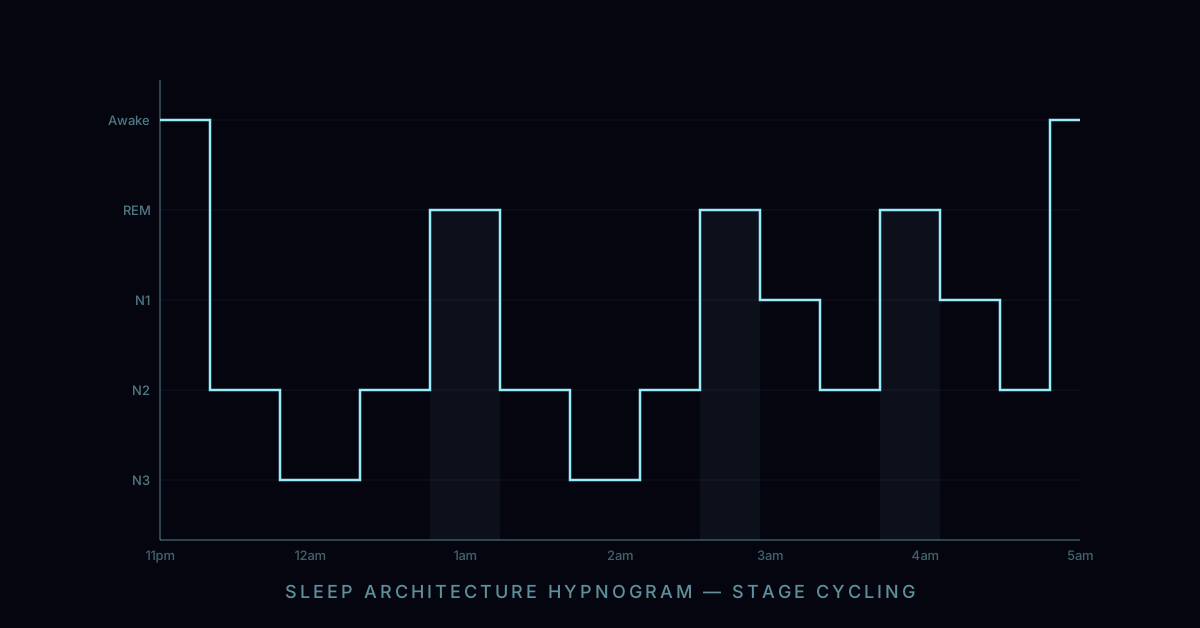
Chronic noise at night elevates cortisol, fragments sleep architecture, and dysregulates the HPA axis in ways that shift clock gene expression in stress-responsive tissues. Our article on chronic noise, stress, and circadian disruption covers the mechanism.
Ageing
The amplitude of circadian rhythms attenuates with age — the peaks get lower and the troughs get higher, reducing the contrast between the circadian day and night phases. The SCN loses neuronal density and coupling efficiency. Evening melatonin levels fall. Older adults tend toward earlier chronotypes with reduced sleep consolidation. Some of the health deterioration of normal ageing is probably circadian in origin.
Health Consequences of Circadian Disruption: What the Evidence Shows
The health consequences of chronic circadian misalignment are not subtle. The mechanisms are now well enough understood that the associations are biologically plausible, and in many cases the causal direction has been established through experimental circadian misalignment studies in humans — not just epidemiology.
Metabolic Disease
Clock genes directly regulate insulin secretion, glucose uptake, and lipid metabolism. A landmark 2009 study by Scheer and colleagues at Harvard forced human subjects into circadian misalignment (sleeping and eating out of phase with their clocks) for three weeks and found that this produced pre-diabetic glucose profiles, elevated blood pressure, and reduced leptin — all markers of metabolic syndrome — in previously healthy adults. Population studies consistently show that shift workers have 40–60% higher rates of type 2 diabetes than matched day workers. Social jet lag magnitude predicts BMI independently of sleep duration.
Cancer
Circadian clock genes function as tumour suppressors in multiple tissues. BMAL1 and PER2 negatively regulate cell cycle progression; mutations in clock genes are enriched in cancers of the breast, colon, endometrium, and prostate. Melatonin, the primary output of the circadian night, directly suppresses tumour growth through multiple mechanisms including antioxidant activity, anti-angiogenic signalling, and direct effects on oestrogen receptor activity. IARC classified shift work involving circadian disruption as a Group 2A probable carcinogen based on sufficient evidence in animals and limited but consistent evidence in humans. The light pollution associations with breast and prostate cancer rates across populations are among the most discussed epidemiological findings in circadian oncology. Our article on light pollution and human health covers this evidence in detail.
Cardiovascular Disease
Blood pressure follows a robust circadian rhythm, normally dipping 10–20% during sleep (the 'dipping' pattern). Non-dippers — people whose blood pressure does not fall appropriately at night — have significantly higher rates of cardiovascular events. Platelet aggregation and coagulation factor activity peak in the morning hours, producing a morning surge in myocardial infarction and stroke risk. The cardiac clock regulates myocardial ischaemic tolerance — the heart is more vulnerable to ischaemic injury in the morning than in the afternoon. Heart failure patients with disrupted circadian gene expression have worse outcomes. Night shift workers have 17–26% higher rates of coronary artery disease in meta-analyses.
Mental Health
The relationship between circadian disruption and mental health is bidirectional and particularly strong. Disrupted circadian rhythms are a core feature of virtually every major psychiatric disorder — depression, bipolar disorder, schizophrenia, anxiety disorders, and ADHD all show characteristic patterns of circadian misalignment in actigraphy and clock gene expression data. Light therapy (see our article on light therapy evidence for depression) is effective for seasonal affective disorder and increasingly recognised as effective for non-seasonal depression — acting through the same melanopsin/SCN/melatonin pathway that mediates circadian entrainment. Our piece on seasonal affective disorder and sunlight covers the circadian basis of winter depression specifically.
Optimising Your Circadian Rhythm: Evidence-Based Priorities
The circadian system is designed to be reset and aligned daily. Every intervention described below exploits a known mechanism; none requires supplements or equipment beyond what is universally available.
Get outdoor light within 30–60 minutes of waking
This is the single highest-leverage circadian intervention. Even 5–10 minutes of outdoor light (no sunglasses) provides 10–50x more circadian-entraining photons than indoor lighting. On overcast days, outdoor light still provides 2,000–10,000 lux vs. 200–500 lux indoors. This morning light exposure drives the cortisol awakening response, anchors the SCN phase, and sets a 14–16 hour countdown to the appropriate onset of melatonin secretion in the evening. See the full morning sunlight protocol.
Eliminate blue light after sunset
Transition to warm-spectrum (2700K or lower) lighting after dark. Enable night mode on all screens. Blue-blocking glasses (amber-tinted, transmitting less than 10% of 450–500 nm light) used from 2–3 hours before bed produce measurable melatonin protection and improved sleep quality in RCT evidence. The goal is to make the evening light environment spectrally similar to firelight, which is what human biology evolved with.
Anchor meal timing to the light-active phase
Peripheral clocks in the liver and gut use meal timing as their primary entrainment signal. Eating within a consistent 8–10 hour window aligned with the daylight hours synchronises hepatic and gut clocks to the SCN. Late-night eating — outside this window — desynchronises peripheral clocks from the master clock, producing metabolic consequences independent of caloric intake. A practical target is completing the last substantial meal 3+ hours before sleep.
Maintain consistent sleep and wake times
Clock entrainment requires a consistent zeitgeber. Variable sleep timing disrupts the phase relationship between the SCN and peripheral clocks. The weekend lie-in is a common culprit: sleeping 2+ hours later on Saturday and Sunday induces a measurable biological phase delay, producing Monday-morning sluggishness that is literally a form of jet lag. Consistent wake time is more important than consistent bed time, because light exposure at a consistent wake time is the primary anchor.
Exercise and outdoor light together, earlier in the day
Exercise is a secondary zeitgeber: morning and afternoon exercise phase-advances the clock in the same direction as morning light; late-evening vigorous exercise delays it (and raises core temperature, which mechanically delays sleep onset). Combining morning outdoor exercise provides both stimuli simultaneously — maximally efficient circadian entrainment.
For people with clinically significant circadian phase disorders — delayed sleep phase syndrome, non-24-hour sleep-wake disorder (particularly in blind individuals), or severe social jet lag — structured light therapy with a medical-grade 10,000 lux lightbox may be indicated. Our articles on circadian phototherapy and sleep latency and light therapy evidence cover the clinical protocols.
Melatonin: The Hormone of Darkness
Melatonin is the primary hormonal output of the circadian night. It is synthesised in the pineal gland from serotonin under the control of the SCN, beginning to rise 1–2 hours before habitual sleep onset, peaking in the middle of the night (around 2–3 AM in a normally entrained individual), and falling to near-zero before waking. Melatonin is not a sedative — it does not knock you out like a sleeping pill. It is a circadian signal: it tells every clock in the body what time it is biologically and prepares tissues for the metabolic quiescence of sleep.
Beyond its circadian signalling role, melatonin is one of the most potent endogenous antioxidants known. It is lipid-soluble and membrane-permeable, crosses the blood-brain barrier, and accumulates in mitochondria, where it directly scavenges reactive oxygen species generated by the electron transport chain during sleep. This mitochondrial antioxidant function is likely why sleep deprivation produces such rapid and measurable increases in oxidative stress markers. Melatonin also has direct anti-tumour effects through inhibition of HIF-1α (hypoxia-inducible factor), suppression of oestrogen receptor signalling in breast cancer cells, and modulation of natural killer cell activity — the oncological relevance of the light-at-night/cancer associations.
As a supplement, melatonin at low doses (0.3–1 mg) taken 1–2 hours before the desired sleep onset is effective for resetting circadian phase (jet lag, shift work adjustment, DSPS) but has modest effects on sleep quality in people without circadian phase misalignment. Very high doses (5–20 mg) commonly sold in US supplements are supraphysiological and may actually reduce the sensitivity of melatonin receptors over time. The European regulatory position — melatonin as a prescription medicine in many countries, with 0.5–2 mg as the recommended range — is probably closer to the physiologically appropriate dose than the US supplement market standard.
Explore the QuanMed AI Platform
Related Articles
Aug 19, 2026
Blue Light and Your Circadian Clock: What Screen Time Is Actually Doing
Your phone's light actively suppresses melatonin and delays your circadian clock through a dedicated neural pathway.
Aug 25, 2026
The Morning Sunlight Protocol: What the Science Says About Light and Waking
Morning sunlight sets your circadian clock, regulates cortisol, and predicts your sleep quality that night.
Aug 27, 2026
Circadian Medicine: Why Timing Your Treatments Could Be as Important as the Dose
The same drug given at different times of day can produce dramatically different effects.
Aug 24, 2026
Light Pollution and Human Health: The Hidden Cost of the Bright Night
More than 80% of the world lives under light-polluted skies. The health consequences are only becoming clearer.
Sep 27, 2026
Chronic Noise, Stress, and Your Circadian Clock: The Health Toll of Living Loud
The WHO classifies noise as the second-largest environmental health risk in Europe. Its effects go far beyond hearing loss.