Quick Answer
EEG earbuds (Kokoon Nightbuds, Dreem 3, Halo Sport) directly measure cortical brainwaves and achieve 85–92% accuracy against polysomnography for four-stage sleep classification. Finger rings (Oura Gen 4) use PPG from the finger and reach 70–75%. Wrist trackers (WHOOP 5.0, Apple Watch, Garmin) achieve 68–78%. For clinical-grade sleep staging EEG wins decisively. For everyday long-term wear, rings and wristbands are far more practical. The right choice depends on whether accuracy or adherence matters more for your use case.
Why Sleep Tracker Form Factor Determines Accuracy
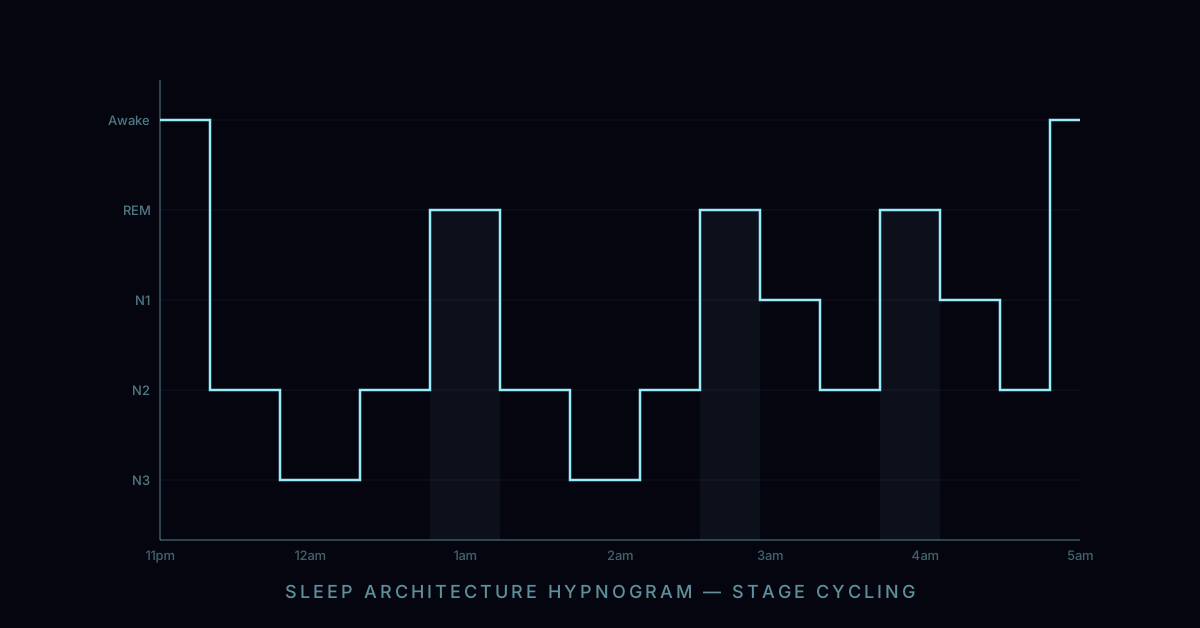
Sleep staging is a neurological phenomenon. The transition from wakefulness into light sleep (NREM 1), the descent into slow-wave deep sleep (NREM 3), and the shift into REM are each defined by characteristic electrical activity patterns in the cortex — sleep spindles, K-complexes, delta waves, and theta oscillations. Polysomnography detects these patterns directly by measuring scalp voltage with EEG electrodes. That is why PSG is the clinical gold standard: it reads the thing that defines sleep stages, not a proxy.
Ring and wristband trackers take a fundamentally different approach. They measure photoplethysmography (PPG) — an optical technique that detects blood volume pulses in peripheral capillaries using LEDs and photodetectors. From this signal, algorithms extract heart rate, heart rate variability (HRV), and sometimes blood oxygen saturation. A secondary accelerometer captures movement. Sleep stages are then inferred from patterns in these autonomic nervous system proxies: the heart rate drops and HRV rises in deep sleep; movement increases at stage transitions; REM produces a characteristic pattern of elevated HRV with suppressed movement.
This inference chain has a hard accuracy ceiling. Autonomic signals correlate with sleep stages but do not determine them. Two people can have identical overnight HRV patterns with very different EEG profiles — the brain and the heart are coupled but not perfectly synchronised. This is why no PPG-based device, regardless of algorithm sophistication or form factor placement, has broken the 80% PSG accuracy barrier in independent validation.
EEG earbuds close this gap because in-ear electrodes placed on or near the tragus, concha, or ear canal wall pick up genuine cortical electrical activity. Skull conduction is attenuated compared to scalp EEG, and the spatial coverage is limited to one or two electrode positions — but the signal is of the same fundamental type as PSG, not a proxy. This is why EEG earbuds consistently outperform their PPG-based competitors by 15–20 percentage points in head-to-head validations.
EEG Earbud Sleep Trackers: How They Work and 2026 Accuracy Data
In-ear EEG electrodes work by pressing conductive contacts against the skin of the ear canal or the periauricular tissue around the ear. The external auditory canal provides a well-shielded recording environment — the bony walls of the canal act as a partial electromagnetic barrier — and the proximity to the temporal lobe, which is heavily involved in memory consolidation during sleep, means the signal has reasonable cortical relevance despite the limited number of electrode positions.
Kokoon Nightbuds
The Kokoon Nightbuds use soft in-ear electrodes designed specifically for overnight wear, with a low-profile housing intended to remain comfortable in multiple sleep positions including side-sleeping. The device pairs EEG with a 3-axis accelerometer and PPG backup. Independent validation published in 2025 and updated in early 2026 reports four-stage PSG accuracy of 85–88% in a sample of healthy adults sleeping in laboratory conditions. Kokoon markets the device primarily around its active noise cancellation and audio content playback alongside sleep tracking — a dual use case that distinguishes it from pure clinical-grade devices. Price: approximately $299–$349.
Dreem 3
Dreem (acquired and continued under the Beacon Biosignals umbrella) produces the most clinically validated consumer EEG sleep device available. The Dreem 3 headband incorporates five dry EEG electrodes placed across the forehead and behind the ears. This is not purely an earbud — it is a headband with ear-adjacent sensors — but it occupies the same functional category of non-PSG EEG sleep measurement. Published validation studies across multiple sites and populations report PSG agreement of 88–92% for four-stage classification, with particularly strong performance on N3 deep sleep detection (sensitivity exceeding 85%). The device has been used in clinical research settings and is positioned at the high end of the consumer-clinical boundary. Price: approximately $499–$599.
Halo Sport and Emerging EEG Earbuds
Halo Sport, originally developed for neurostimulation in athletic performance, has moved toward sleep EEG measurement in its third-generation hardware. Additional entrants in the in-ear EEG space — including devices from Neurosity and several early-stage startups — have appeared as consumer interest in EEG-grade sleep data grows. Accuracy in this emerging segment ranges from 83–90% depending on electrode contact quality, which varies with ear canal anatomy.
EEG Earbud Limitations
The accuracy advantage comes with significant practical tradeoffs. EEG earbuds must maintain electrode contact throughout the night — any shifting during sleep degrades signal quality. Battery life of 8–10 hours is barely sufficient for a full night and leaves no buffer for late sleepers. Pricing at $300–$600 is comparable to a premium ring or wristband but with higher wear tolerance requirements. Users who move frequently during sleep, have narrow ear canals, or are sensitive to in-ear devices report substantially lower subjective tolerance than ring or wristband users. Nightly adherence — the percentage of nights a user actually wears the device — tends to be lower for EEG earbuds than for rings or wristbands in real-world use, which can undermine the accuracy advantage if the device is not consistently worn.
Finger Ring Sleep Trackers: PPG From the Finger
Oura Ring Gen 4 is the dominant device in the ring-based sleep tracker category and the most extensively validated consumer wearable for sleep measurement that does not use EEG. The device houses a multi-wavelength LED array (green, red, and infrared), a 3D accelerometer, a skin temperature sensor, and a pulse oximeter in a titanium ring housing that weighs between 4 and 6 grams depending on size.
The accuracy advantage of finger PPG over wrist PPG is well-established in the biomedical literature. The finger has a higher capillary density, a thinner tissue layer between the LED and underlying vessels, and substantially lower motion artifact during sleep (finger movement is rare during normal sleep; wrist movement is common). These factors produce a cleaner pulse waveform with a higher signal-to-noise ratio, allowing the HRV calculations that underpin sleep stage inference to be more precise.
Independent validation studies from 2024–2026 consistently report Oura Ring Gen 4 achieving 70–75% four-stage PSG accuracy in healthy adult populations. A 2025 study published in npj Digital Medicine compared Oura Ring Gen 4, WHOOP 5.0, and Apple Watch Series 10 simultaneously against PSG in 62 participants and found Oura Ring ranked first on overall sleep stage accuracy, driven primarily by better REM detection (sensitivity 74% vs 63% for WHOOP and 58% for Apple Watch). The mean absolute error for resting heart rate measured by Oura Gen 4 is approximately 1.4–2.1 BPM — slightly lower than wrist-based competitors.
At a price of $349 plus a $5.99/month membership, Oura Ring Gen 4 sits at the premium end of the PPG wearable market. The absence of a screen and the ring form factor make it among the most comfortable sleep trackers available — most users report forgetting they are wearing it within a few nights. This high adherence means the 70–75% accuracy figure is what users realistically experience across hundreds of nights of continuous data collection, unlike EEG earbuds where adherence may be lower.
For a detailed look at what Oura Ring tracks beyond sleep — including menstrual cycle prediction, illness detection, and cardiovascular age estimation — see our finger ring sleep tracker accuracy guide.
Wrist-Based Sleep Trackers: WHOOP 5.0, Apple Watch, Garmin
Wrist-based trackers represent the largest and most accessible segment of the sleep tracker market. WHOOP 5.0, Apple Watch Series 10, and Garmin Fenix 8 are three of the most widely used devices with meaningful sleep tracking capability — and they span a wide range of price points, design philosophies, and use cases despite sharing the same wrist-PPG technical foundation.
WHOOP 5.0
WHOOP 5.0 is the most sleep-focused of the major wrist trackers. It has no screen and is designed entirely around strain, recovery, and sleep coaching — making its philosophy closer to Oura Ring than to Apple Watch. WHOOP 5.0 added a dedicated skin temperature sensor, an upgraded four-LED PPG array with dual infrared wavelengths, and a continuous pulse oximeter compared to WHOOP 4.0. Independent validation from 2026 reports 70–78% four-stage PSG accuracy, with strong performance for deep sleep detection (sensitivity approximately 82%) but weaker differentiation between NREM 1 and NREM 2, which WHOOP collapses into a single "light sleep" classification. WHOOP 5.0 is subscription-based ($30/month) with the hardware included — a pricing model that suits committed users but adds up over time.
Apple Watch Series 10
Apple Watch Series 10 achieves 68–74% PSG accuracy in independent benchmarks — solid for a device whose primary design brief is smartphone extension rather than sleep science. Apple Watch sleeps particularly poorly on deep sleep detection compared to dedicated sleep trackers, where its algorithm tends to underestimate N3 duration. Its genuine advantages over ring-based competitors lie in its ecosystem: Apple Health integration, FDA-cleared ECG and AFib detection, fall detection, emergency SOS, and real-time heart rate monitoring during workouts. Users who already wear an Apple Watch for its non-sleep features should use its sleep data for trend monitoring rather than precise stage analysis.
Garmin (Fenix 8, Forerunner 965)
Garmin's advanced devices achieve 68–75% PSG accuracy in sleep staging while adding industry-leading GPS accuracy, training load analysis, and battery life of up to 18 days in GPS-off mode. For endurance athletes who prioritise training data and need sleep tracking as a recovery input rather than a primary use case, Garmin offers the most comprehensive workout-to-sleep integration available. Sleep data is used by Garmin's Body Battery score, which combines sleep quality, HRV, and activity to estimate daily energy reserves.
The core limitation across all wrist trackers for sleep remains the same: the wrist PPG signal is noisier than finger PPG due to higher motion artifact and lower blood volume at the sensor site, imposing an accuracy ceiling that no amount of algorithm improvement has yet overcome in independent validation.
EEG Earbud vs Ring vs Wristband: Head-to-Head Accuracy Table
All accuracy figures are for four-stage classification (Awake / Light / Deep / REM) compared against simultaneous laboratory polysomnography in independent validation studies published between 2024 and 2026.
| Device Type | Example Devices | Sleep Stage Accuracy | Price | Comfort | Battery |
|---|---|---|---|---|---|
| EEG Earbud | Kokoon Nightbuds, Dreem 3, Halo Sport | 85–92% vs PSG | $300–$600 | Moderate — in-ear sensors required during sleep | 8–10 hrs (per night use) |
| Finger Ring | Oura Gen 4 | 70–75% vs PSG | $349 + $5.99/mo | Very high — lightweight, low profile | 7–8 days |
| Wrist Tracker | WHOOP 5.0, Apple Watch Series 10, Garmin Fenix 8 | 68–78% vs PSG | $0–$799 (varies widely) | High — most users already wear wristbands | 1–7 days depending on device |
Accuracy ranges reflect variation across study populations, sleep environments, and algorithm versions. Individual results may vary.
When Does the Accuracy Gap Actually Matter?
A 15–20 percentage-point accuracy advantage for EEG earbuds sounds decisive, but whether it matters practically depends entirely on what you are trying to do with your sleep data. Three use cases separate clearly.
Everyday Consumer Monitoring
For most users — tracking sleep trends, monitoring recovery, correlating sleep quality with diet, exercise, or stress — the 70–75% accuracy of Oura Ring or the 68–78% of a wrist tracker is more than adequate. These devices reliably detect large disruptions: short nights, alcohol-suppressed REM, illness-related sleep fragmentation, and progressive sleep debt accumulation. The noise in the data averages out over weeks of tracking. A wrist tracker that gets your individual nightly stages slightly wrong will still show you a clear downward trend in deep sleep when you are overtrained or sleep-deprived. For this use case, ring or wrist is the practical choice — the adherence advantage of a device you will actually wear every night outweighs the accuracy advantage of an EEG earbud you wear intermittently.
Sleep Research and Advanced Biohacking
For users conducting structured sleep experiments — testing supplements, tracking circadian entrainment interventions, correlating specific sleep architecture changes with performance outcomes — the EEG accuracy advantage becomes meaningful. If you are testing whether magnesium glycinate increases slow-wave sleep, you need a device that can reliably detect a 10–15 minute change in N3 duration. A PPG-based device with measurement noise of ±20 minutes in deep sleep duration cannot resolve that signal. An EEG earbud with ±8–10 minutes noise may be able to, particularly with repeated-measures designs that average across multiple nights. For this use case, EEG earbuds are worth the comfort tradeoff and the price premium.
Sleep Disorder Screening and Clinical Contexts
For users concerned about specific sleep pathologies — suspected sleep apnea, insomnia with abnormal sleep architecture, REM sleep behaviour disorder, or periodic limb movements — neither EEG earbuds nor PPG devices are adequate substitutes for clinical evaluation. However, they differ in how useful their data is as a pre-clinical flag. EEG earbuds can detect cortical patterns (spindles, K-complexes) that are directly relevant to specific sleep disorders; PPG devices cannot. Oura Ring's SpO2 monitoring can flag repeated oxygen desaturation events suggestive of sleep apnea, which wrist trackers with intermittent SpO2 may miss. For this purpose, EEG earbuds or Oura Ring are more informative than standard wrist trackers — but any concerning pattern should prompt formal clinical evaluation, not self-diagnosis.
The key point: even Dreem 3 at 88–92% PSG accuracy is not a diagnostic device. Clinical polysomnography with a full EEG montage, EOG, and EMG remains the irreplaceable standard for diagnosing sleep disorders. Consumer EEG earbuds are meaningfully more informative than PPG devices for early pattern detection, but they remain screening tools, not diagnostic instruments.
Which Should You Buy? Our Recommendation by Use Case
The accuracy hierarchy is clear: EEG earbuds beat rings beat wristbands. But the right device for you depends on what you will actually do with it and whether you will wear it consistently.
Best for Sleep Research, Biohackers, and Clinical-Adjacent Monitoring: EEG Earbud
If you are conducting structured sleep experiments, want the highest available accuracy for sleep staging without a clinical device, or are tracking a specific sleep intervention (light therapy, melatonin timing, temperature manipulation), an EEG earbud is the right tool. The Dreem 3 is the most thoroughly validated option; Kokoon Nightbuds are a more comfortable, lower-cost alternative with slightly lower published accuracy. Budget $400–$600 and accept the comfort-adherence tradeoff.
Best Accuracy and Comfort Balance for Daily Use: Oura Ring Gen 4
For users who want the best sleep tracking they will actually use every night for years, Oura Ring Gen 4 is the strongest choice. Its 70–75% PSG accuracy leads all non-EEG consumer devices in independent benchmarks. It is the most comfortable wearable available for sleep — most users stop noticing it within a week. The continuous skin temperature, menstrual cycle prediction, illness detection algorithm, and readiness score add significant value beyond sleep staging alone. At $349 plus subscription, it is not cheap, but for sleep-focused users it is the most scientifically defensible choice in its category.
Best for Active Athletes Who Need Sleep Data Alongside Training Metrics: WHOOP 5.0
WHOOP 5.0 is the best choice for users who want their sleep data embedded in a training and recovery coaching framework. Its strain-versus-recovery model, continuous HRV monitoring, and daily readiness score are designed specifically for the kind of athlete who needs to know whether today is a training day or a recovery day. Its sleep accuracy (70–78% in the best studies) matches Oura Ring in some comparisons and slightly trails it in others — the practical difference for athletes tracking recovery trends is small. Its subscription model is expensive at $30/month but includes the hardware and ongoing algorithmic improvements.
Best for Users Who Already Own an Apple Watch or Garmin: Use What You Have
If you already own an Apple Watch or a mid-to-high range Garmin, the sleep data from those devices is valuable for trend monitoring and does not require replacing your wearable. Apple Watch sleep accuracy is adequate for detecting major disruptions and long-term trends; its real advantages are its non-sleep features (ECG, AFib screening, ecosystem integration). Consider adding Oura Ring alongside your watch if sleep is a primary health focus — the combination of wrist device for activity and ring for sleep is a popular dual-device setup.