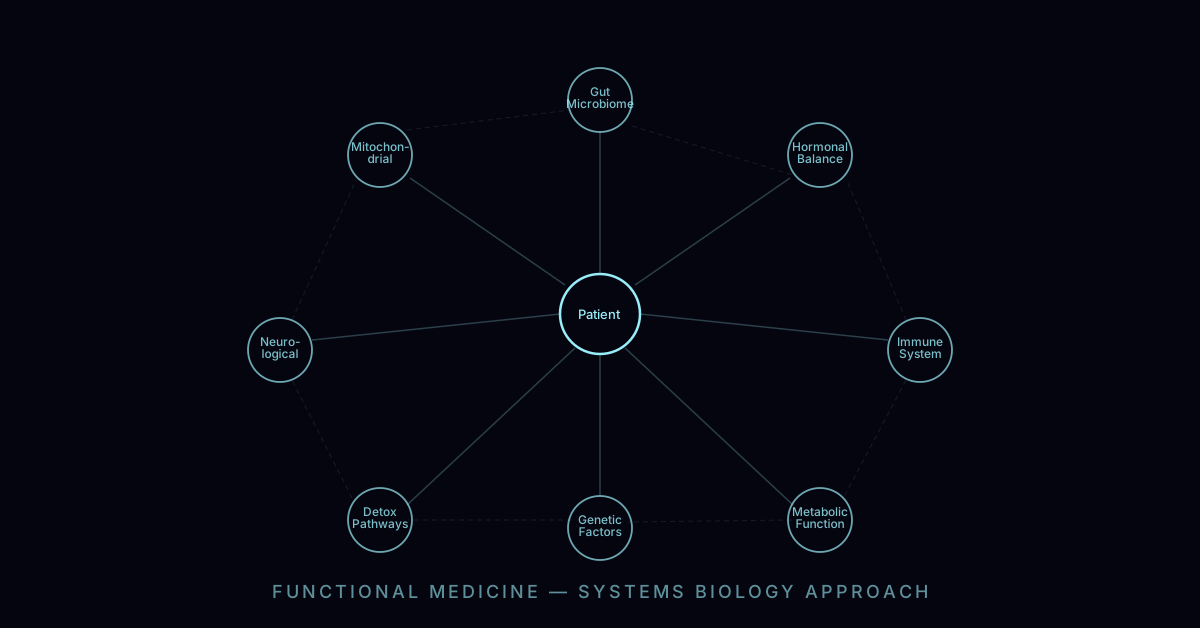
Interest in quantum medicine and quantum biology-informed health approaches has grown substantially as mainstream medicine's limitations for chronic disease become apparent. With this growth comes a proliferation of practitioners — from rigorously trained integrative physicians to wellness influencers selling expensive protocols without clinical training. This guide helps you navigate the landscape and find legitimate, evidence-based care.
What Quantum Medicine Means in Legitimate Clinical Practice
Before evaluating practitioners, it helps to understand what a genuinely evidence-based quantum medicine framework looks like in practice. Legitimate quantum medicine draws on real quantum biology research in four main areas:
- Mitochondrial optimization: Supporting mitochondrial electron transport chain function through targeted nutrients (CoQ10, B vitamins, magnesium), reducing mitochondrial toxins (heavy metals, certain medications, excessive EMF), and promoting mitochondrial biogenesis through exercise, fasting, and cold exposure
- Photobiomodulation: Using clinically validated red and near-infrared light (630–660nm, 810–850nm) for documented applications — wound healing, joint pain, skin rejuvenation, muscle recovery — based on cytochrome c oxidase activation mechanisms
- Circadian biology: Optimizing light-dark exposure patterns, meal timing relative to circadian phase, and sleep architecture — all grounded in SCN photoentrainment and clock gene research
- Light environment medicine: Addressing the mismatched light environment of modern life (artificial light at night, insufficient morning sunlight) as a driver of metabolic and psychiatric dysfunction
Practitioners doing this work competently are typically trained in functional or integrative medicine and apply these quantum biology lenses within a rigorous diagnostic framework.
Credential Guide: What to Look For
IFM Certified Practitioner (IFMCP)
The Institute for Functional Medicine's IFMCP designation is the most rigorous and widely recognized functional medicine certification. Obtaining it requires completing IFM's Applied Clinical Training (specific modules covering cardiometabolic, immune, hormonal, and gastrointestinal medicine), passing a comprehensive competency exam, and submitting case studies demonstrating clinical application. The IFM maintains a searchable practitioner directory at ifm.org/find-a-practitioner. IFMCP-certified practitioners have demonstrated both knowledge and clinical application — not just course completion.
ABIHM Board Certification
The American Board of Integrative and Holistic Medicine certifies physicians (MD/DO) and naturopathic doctors (ND) in integrative medicine through a board exam process. ABIHM-certified practitioners have formal training in evidence-based integrative approaches alongside conventional medical training. The ABIHM directory is at abihm.org.
A4M Fellowship (FAARM) and ABAARM Certification
The American Academy of Anti-Aging Medicine offers the FAARM fellowship and ABAARM board certification in anti-aging, regenerative, and functional medicine. Quality varies among A4M-affiliated practitioners — the A4M conference is a large tent that includes both rigorous clinicians and commercial supplement promoters. Use A4M certification as a starting point for inquiry, not a guarantee of quality.
Naturopathic Doctors (ND)
Licensed naturopathic doctors in jurisdictions where they have prescriptive authority (most US states, Canada) can provide comprehensive functional and quantum medicine care. NDs from accredited four-year programs (Bastyr University, NCNM, SCNM, CCNM, NUHS) have rigorous training in nutrition, botanical medicine, and clinical diagnostics. Verify that an ND is licensed and graduated from an accredited institution — "naturopath" is an unprotected title in many jurisdictions, and anyone can use it without clinical training.
Red Flags: Practitioners to Avoid
Vague Quantum Claims Without Mechanism
Legitimate quantum medicine practitioners can tell you specifically which quantum effect, in which protein or cellular structure, underlies their recommended intervention. If a practitioner's explanation of quantum medicine is "your body has a quantum energy field and our treatment harmonizes it" — without specifying mechanism, tissue, or measurable parameter — this is a red flag. Real quantum biology is mechanistically specific; pseudoscience is purposefully vague.
Proprietary "Quantum" Devices Without Published Evidence
Some practitioners sell proprietary scanning devices, treatment devices, or supplements claiming to work via quantum mechanisms, at high markups, without peer-reviewed evidence for their specific products. Red-light panels with verified specs and published irradiance data are legitimate; "quantum bioresonance" devices that claim to diagnose and treat through unspecified quantum frequencies are not. If a practitioner's practice is primarily organized around selling expensive proprietary products, treat the clinical recommendations with proportionate skepticism.
Rejection of Conventional Medicine
Quantum medicine at its best complements conventional medicine — it does not replace it. A practitioner who advises against cancer screening, recommends stopping prescription medications without medical supervision, or discourages specialist referral for serious conditions is a safety risk regardless of their other competencies. The best integrative practitioners collaborate with conventional specialists and know when to refer.
Non-Validated Diagnostics
Live blood analysis, iridology, electrodermal testing, and quantum "bioscanning" devices have not been validated as diagnostic tools in peer-reviewed research. Practitioners who use these methods as primary diagnostic tools — rather than relying on validated lab tests and clinical assessment — are practicing outside the evidence base. This is distinct from practitioners who use advanced but validated labs (organic acids testing, comprehensive metabolomics, advanced lipid panels) that extend beyond standard care.
Questions to Ask a Prospective Practitioner
Quantum and functional medicine are largely unregulated fields — the labels can be applied by anyone, from rigorously trained integrative physicians to wellness influencers with a weekend certification. The right questions cut through that ambiguity quickly. The six questions below are designed to elicit specific, verifiable answers: a practitioner with genuine training and evidence-based practice will answer them easily, while one operating primarily on narrative rather than science will deflect, generalise, or become defensive. Pay attention to how they answer, not just what they say.
- What specific training do you have in functional or integrative medicine, and are you board-certified or IFM-certified?
- How do you approach diagnosis — what labs do you use, and why?
- Can you explain the mechanism behind one of your core interventions (e.g., photobiomodulation or circadian protocols)?
- How do you collaborate with conventional specialists when patients need standard care?
- Do you have experience with patients with my specific concerns or conditions?
- What does a typical protocol look like, and what are the expected costs for the first 3–6 months including labs?
The quality of the answers matters as much as the answers themselves. Legitimate integrative and functional medicine practitioners are comfortable discussing their evidence base, acknowledging limits of certainty, and explaining why they prioritise specific tests over others. A practitioner who answers question one with a specific board certification or IFM completion date and question four with a discussion of study quality is demonstrating the epistemic honesty that separates evidence-informed practice from wellness marketing. If cost transparency is avoided in question six, that pattern predicts how the financial relationship will proceed throughout the therapeutic relationship.
Telehealth Options and Directory Resources
Most functional and quantum medicine practitioners now offer telehealth consultations — making geography far less limiting than a decade ago. Platforms connecting patients with IFM-certified practitioners include: IFM's practitioner finder (ifm.org), Rupa Health's practitioner network, Parsley Health (functional medicine primary care with telehealth), Wild Health (genetics-guided personalized medicine via telehealth), and the ABIHM directory.
QuanMed AI connects patients with practitioners familiar with quantum biology frameworks specifically — contact the platform for practitioner referrals oriented toward photobiomodulation, circadian medicine, and mitochondrial optimization. This narrows the search to practitioners who have engaged with the specific evidence base underlying these approaches, rather than generalist integrative practitioners who may not have explored quantum biology depth.
What Legitimate Practitioners Cost
Budget transparency helps set expectations. Initial functional medicine consultations: $300–$600 (physician), $150–$350 (non-physician practitioner). Comprehensive lab panel (first-time patient): $500–$2,000. Ongoing follow-up consultations: $150–$400. Annual total for initial workup plus 3–4 follow-ups plus labs: $2,000–$5,000. Direct primary care functional medicine memberships: $150–$400/month all-inclusive for consultations (labs billed separately). Most costs are out-of-pocket, though some lab work and some physician visits may be partially covered by insurance with a referral or if the practitioner also takes insurance for conventional services.
These figures look significant compared to insurance-based conventional care, but the comparison understates what you are actually getting. A comprehensive initial consultation with a functional medicine physician runs 90 minutes or more — versus the national average of 15 minutes for a GP visit. That time includes a detailed history, a review of prior labs, and the construction of a personalised protocol rather than a symptom-matched prescription. The first-year lab spend also includes advanced testing — comprehensive metabolomics, organic acids, advanced lipid panels, hormone mapping — that standard care rarely orders until problems become acute. For context, many patients seeking this type of care already spend comparable amounts annually on supplements purchased without clinical guidance, often with far less measurable return. More importantly, a practitioner who identifies a root-cause driver — poor mitochondrial function, undiagnosed thyroid dysfunction, circadian disruption — and addresses it directly can reduce long-term costs substantially by cutting years of symptom management, repeat specialist referrals, and escalating prescriptions that treat downstream effects rather than the underlying cause.