Why Sleep Architecture Matters More Than Duration Alone
Total sleep duration receives most of the public health attention, and rightly so — chronic sleep restriction is a major population health problem. But for the large percentage of adults who are already sleeping 7–8 hours and still feel unrestored, the problem is often not duration but sleep architecture: the proportion, sequence, and depth of sleep stages within the night. You can sleep 8 hours and have profoundly inadequate slow-wave (N3) deep sleep if specific factors are disrupting your architecture. Understanding and optimizing these factors is the frontier of practical sleep medicine.
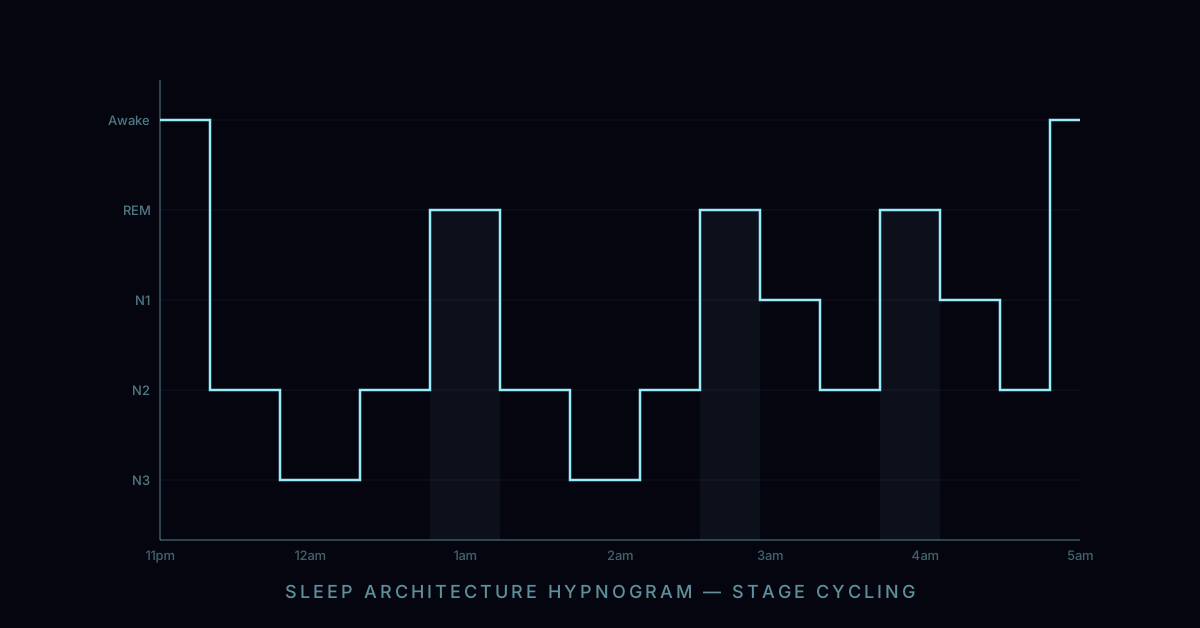
Sleep architecture is the temporal distribution of sleep stages across the night. A healthy night cycles through NREM stages N1 (light sleep, minutes), N2 (sleep spindles and K-complexes, approximately 50% of total sleep time), and N3 (slow-wave sleep / delta sleep) — followed by REM sleep. This cycling repeats approximately 4–6 times per night, with slow-wave sleep (N3) concentrated in the first half of the night and REM sleep concentrated in the second half. N3 is the most anabolically active sleep stage: growth hormone secretion peaks during the first N3 cycle (accounting for the majority of the nightly GH pulse), immune function restoration occurs, metabolic waste clearance via the glymphatic system is maximal, and declarative memory consolidation — the transfer of facts and events from hippocampus to cortex — is deepest. REM sleep is essential for emotional memory processing, procedural skill consolidation, and the integration of new information with prior knowledge. Disrupting either stage produces specific deficits: insufficient N3 impairs physical recovery and immune function; insufficient REM impairs emotional regulation and cognitive flexibility.
What Damages Sleep Architecture: The Primary Disruptors
Before exploring enhancement strategies, the single most impactful action for most adults is eliminating the common disruptors of sleep architecture. Several ubiquitous substances and behaviors specifically suppress N3 and REM without necessarily causing obvious sleep disruption that the sleeper detects.
Alcohol
Alcohol is the most widely used sleep disruptor in the developed world. Its GABA-A agonist mechanism produces sedation, but as discussed elsewhere, the metabolic rebound in the second half of the night produces neurochemical hyperexcitability that fragments slow-wave and REM sleep. Even one to two drinks within 3 hours of bedtime measurably reduces REM sleep in the first two cycles. Eliminating alcohol completely for 2–3 weeks is the most powerful single intervention for many adults experiencing poor sleep quality.
Cannabis/THC
THC suppresses REM sleep via cannabinoid CB1 receptor activation in the brainstem circuits that regulate REM (including the pedunculopontine nucleus). Multiple PSG studies confirm acute THC administration markedly reduces REM sleep percentage and density. With chronic use, the suppression diminishes somewhat due to CB1 receptor downregulation, but withdrawal after chronic use produces severe REM rebound with extremely vivid and often disturbing dreaming — the "cannabis withdrawal insomnia" phenomenon. CBD in isolation appears to have different and potentially mild sleep-promoting effects, but most commercial products contain a THC:CBD mixture. If using cannabis regularly, understand that your REM sleep is substantially suppressed, with corresponding deficits in emotional processing and procedural memory consolidation.
Benzodiazepines and Z-Drugs
Benzodiazepines (diazepam, temazepam, lorazepam) and Z-drugs (zolpidem/Ambien, zopiclone, eszopiclone) all reduce slow-wave sleep, despite increasing total sleep time and subjective sleep satisfaction. They act as positive allosteric modulators at GABA-A receptors, but they engage different receptor subunit combinations than natural sleep — enhancing alpha-1 subunit GABA-A receptors (which produce sedation) rather than the alpha-1/delta combination that generates natural slow-wave sleep. PSG studies consistently show that these medications reduce slow-wave sleep amplitude and density while artificially maintaining total sleep time, and produce tolerance within days to weeks with rebound insomnia on discontinuation. The AASM's 2022 clinical guidelines no longer recommend Z-drugs as first-line treatment for chronic insomnia; CBT-I (Cognitive Behavioral Therapy for Insomnia) is the recommended first-line treatment.
Blue Light and Irregular Timing
Blue-wavelength light (480nm peak) suppresses melatonin synthesis and shifts the circadian clock. The intrinsically photosensitive retinal ganglion cells (ipRGCs) expressing melanopsin are maximally sensitive to this wavelength and relay light signals to the SCN. Evening blue light exposure — from screens, LED lighting, overhead fluorescent lights — delays the circadian phase and suppresses the melatonin rise that normally gates sleep onset, specifically reducing REM sleep in early-night cycles. A 2014 PNAS study by Chang and colleagues found that 2 weeks of pre-sleep light-emitting eReader use reduced next-morning alertness, suppressed melatonin by 50%, delayed REM onset, and impaired alertness the following morning.
Exercise: The Most Powerful Natural Enhancer of Deep Sleep
Moderate-to-vigorous aerobic exercise and HIIT are the most evidence-backed lifestyle interventions for increasing slow-wave sleep. The mechanisms are multiple and synergistic: acute exercise increases adenosine production (augmenting homeostatic sleep pressure), elevates body temperature (requiring greater post-exercise cooling that drives deeper sleep), increases BDNF (supporting thalamo-cortical circuit function), and reduces chronic cortisol and sympathetic tone that would otherwise fragment N3.
The Buman et al. 2015 meta-analysis in Sleep Medicine Reviews, synthesizing 66 RCTs, confirmed the acute slow-wave sleep enhancement effect across exercise types. The magnitude of the effect was dose-dependent, with vigorous intensity producing greater N3 augmentation than moderate intensity. Resistance training also increases slow-wave sleep, likely through its impact on GH secretion, tissue repair demands, and adenosine production.
Optimal timing: morning to early afternoon (before 3pm) produces the most consistent benefits and avoids the potential sleep onset delay from evening vigorous exercise. However, even evening moderate-intensity exercise (brisk walking, yoga, light cycling) does not impair sleep for most people and is far preferable to no exercise.
Temperature Optimization: The 65°F Rule and the Warm Bath Paradox
Core body temperature must fall by approximately 1–3°F for sleep onset to occur and N3 to be achieved. Bedroom temperature directly governs this thermoregulatory process. The Okamoto-Mizuno 2012 study in Ergonomics established 65–68°F (18–20°C) as the optimal range for maximizing N3 sleep and minimizing awakenings. Above 75°F, sweating, tachycardia, and thermal arousals fragment slow-wave sleep. Below 54°F, metabolic heat conservation increases cortical arousal.
The counterintuitive warm bath intervention — taking a 104–108°F bath or shower 1–2 hours before bed — accelerates the core cooling process through vasodilation-mediated heat dissipation. The 2019 meta-analysis by Haghayegh and colleagues in Sleep Medicine Reviews quantified this effect: a 10-minute improvement in sleep onset latency and a meaningful increase in slow-wave sleep. This is a zero-cost, side-effect-free intervention with level-1 evidence.
Evidence-Based Supplements for Sleep Architecture
Several supplements have meaningful, study-backed evidence for improving sleep architecture specifically — as measured by polysomnography (PSG), the gold-standard laboratory sleep measurement — rather than simply producing sedation. The distinction matters: sedating substances (benzodiazepines, antihistamines, alcohol) increase drowsiness and may improve subjective sleep quality while actually suppressing or fragmenting the restorative slow-wave and REM stages that produce the biological benefits of sleep. Evidence-based sleep supplements work through mechanisms that support the neurochemical processes underlying natural sleep stages rather than bypassing them.
Magnesium is the most evidence-supported supplement for slow-wave sleep specifically. The Held et al. 2002 double-blind RCT in Pharmacopsychiatry demonstrated that 300mg of magnesium supplementation significantly increased N3 sleep as measured by PSG, reduced cortisol (by 29%), and improved subjective sleep quality in older adults. Magnesium's mechanism is multi-pronged: it potentiates GABA-A receptor sensitivity (GABA is the primary neurotransmitter for maintaining NREM sleep), inhibits NMDA receptors (reducing cortical hyperarousal), and is required for the enzymatic conversion of serotonin to melatonin. Western populations are commonly magnesium-insufficient — surveys estimate 45–50% of Americans consume below the 400mg/day RDA — making supplementation particularly impactful when insufficiency is the underlying cause of poor sleep architecture. The table below summarizes the evidence-based options:
| Supplement | Primary Mechanism | Evidence Level | Dosing |
|---|---|---|---|
| Magnesium glycinate | GABA-A potentiation, NMDA inhibition, cortisol reduction | RCT (Held 2002, Pharmacopsychiatry) | 300–400mg elemental, 60 min before bed |
| L-theanine | Alpha-wave promotion, GABA/glutamate modulation | Multiple RCTs | 200–400mg, 30 min before bed |
| Tart cherry concentrate | Melatonin precursors, proanthocyanidins | RCT (Pigeon 2010, J Medicinal Food) | 30ml x2/day (morning + evening) |
| Phosphatidylserine | HPA axis dampening, cortisol reduction | RCT in athletes | 400mg/day before bed |
| Glycine | Core temperature reduction, inhibitory NT | RCT (Bannai 2012, Sleep and Biological Rhythms) | 3g, 30 min before bed |
The supplement evidence table reveals an important hierarchy of intervention that marketing materials routinely obscure. First-line options — magnesium glycinate and L-theanine — carry the most safety data and show modest but consistent effect sizes replicated across multiple study populations; these are appropriate for nearly anyone without contraindications. Second-line options — glycine and apigenin — have mechanistic plausibility and early RCT data supporting their use, but the trials are smaller and less replicated, positioning them as reasonable additions for individuals who have not achieved full benefit from first-line options. The critical context is that supplements address specific deficiencies or receptor states, not universal sleep impairment — magnesium's sleep benefits, for instance, are most pronounced in the substantial portion of the Western population that is chronically magnesium-insufficient (surveys estimate 45–50% of Americans consume below the 400mg RDA), and may be negligible in those who are already replete. Most importantly, none of the supplements in this table should serve as the first-line approach before sleep hygiene fundamentals are established. Consistent timing, bedroom temperature optimization, and light management all carry larger effect sizes than any single supplement — the supplements are best understood as targeted amplifiers of a solid sleep architecture foundation, not replacements for it.
Consistent Wake Time: The Circadian Anchor
Among all behavioral interventions, maintaining a consistent wake time — including weekends — is the single most powerful tool for aligning the two processes that govern sleep architecture. The circadian clock (Process C) is entrained by consistent wake times far more robustly than by consistent bedtimes, because the SCN uses the morning cortisol rise and light exposure at waking to set its 24-hour rhythm. Variable wake times (sleeping in on weekends) shift the circadian phase and delay the melatonin rise on subsequent evenings, fragmenting the first half of the night.
A consistent wake time also calibrates homeostatic sleep pressure (Process S): waking at the same time each day ensures that the accumulated adenosine drive at the next night's bedtime is consistent, producing reliable slow-wave sleep depth in the first cycle — the most critical cycle for N3.
Sleep Restriction Therapy for Architecture Consolidation
For individuals with chronic insomnia and fragmented sleep architecture, sleep restriction therapy (SRT) — the core behavioral component of CBT-I — can dramatically improve sleep efficiency and consolidate deep sleep. The protocol involves temporarily limiting time in bed to the actual hours of sleep achieved (e.g., if you sleep 5.5 hours despite 8 hours in bed, restrict time in bed to 5.5 hours). This builds sleep pressure that consolidates and deepens the subsequent night's sleep. Over 4–6 weeks, time in bed is extended incrementally as sleep efficiency improves above 85%. Multiple RCTs confirm CBT-I produces more durable improvements in sleep architecture than any pharmacological intervention, with remission rates of 70–80% for chronic insomnia.
Sleep restriction therapy works because it temporarily intensifies homeostatic sleep pressure (Process S) — the adenosine-driven "sleep debt" that accumulates during wakefulness. By shortening time in bed to match actual sleep duration, SRT ensures that the sleeper reaches bed with sufficient adenosine drive to fall asleep quickly and consolidate into deep N3 sleep. The temporary sleep deprivation is the mechanism, not a side effect — it breaks the cycle of lying in bed awake, which conditions the brain to associate the bed with wakefulness (conditioned arousal). CBT-I is recommended first-line by the AASM, the American College of Physicians, and the UK NICE guidelines over hypnotic medications for chronic insomnia, based on superior long-term outcomes and absence of tolerance or dependence.
The Complete Sleep Architecture Protocol
Integrating the evidence above into a practical approach: begin by eliminating the primary disruptors — reduce or eliminate alcohol within 3 hours of bedtime, avoid THC if REM quality is a concern, and address any benzodiazepine use with a physician (CBT-I is the evidence-based alternative). These removals often produce the largest and fastest architecture improvements.
Environmental optimization is the next tier: cool the bedroom to 65–68°F (18–20°C), take a warm bath or shower at 104–108°F approximately 1–2 hours before bed, and eliminate blue-wavelength light exposure from screens and overhead lighting in the 1–2 hours before sleep onset. Use warm-spectrum bulbs (below 3000K) or dim red-spectrum lighting in the evening hours. These interventions are free, have no side effects, and are backed by level-1 evidence.
Exercise timing and supplementation round out the protocol: perform vigorous aerobic or resistance training in the morning or early afternoon (before 3pm) to maximize the slow-wave sleep augmentation effect. Add magnesium glycinate 300–400mg elemental 60 minutes before bed as the foundational supplement; consider adding glycine 3g for its core temperature-reducing mechanism. For individuals with persistent architecture fragmentation despite these measures, CBT-I with a trained sleep specialist is the highest-evidence next step — more effective and more durable than any supplement or pharmacological intervention.