The Architecture of Sleep: An Overview
Sleep is not a passive, uniform state of unconsciousness. It is a highly organized, cyclically structured biological process during which the brain and body perform critical maintenance that cannot occur during wakefulness. Understanding sleep architecture — the sequence, proportion, and function of each sleep stage — is the foundation of evidence-based sleep optimization and the starting point for interpreting data from modern wearable trackers.
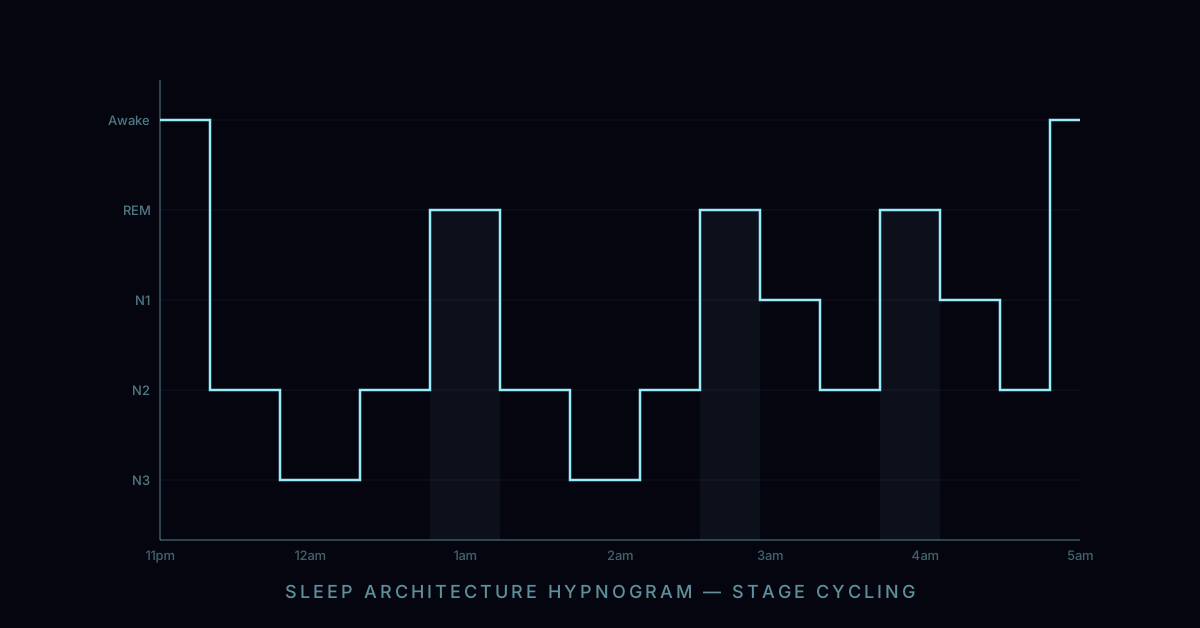
A full night of sleep consists of approximately 4–6 complete sleep cycles, each lasting roughly 90 minutes on average. Each cycle contains a predictable progression through the stages of non-rapid eye movement (NREM) sleep, followed by a period of rapid eye movement (REM) sleep. The balance of stages shifts across the night: early cycles are dominated by deep, slow-wave sleep, while later cycles are dominated by REM. This differential timing matters enormously for understanding why sleep quality depends not just on total duration but on how sleep is distributed across the night.
NREM Sleep: Stages N1, N2, and N3
NREM sleep is divided into three stages — N1, N2, and N3 — each with distinct electrophysiological signatures and physiological functions.
N1: Light Sleep Transition
N1 is the lightest stage of sleep, lasting only 1–7 minutes and representing approximately 5% of total sleep time. The EEG transitions from waking alpha waves (8–13 Hz) to slower theta waves (4–7 Hz). This is the hypnagogic stage — many people experience sudden muscle jerks (hypnic jerks) and fragmentary dreamlike imagery. Individuals woken from N1 often don't believe they were asleep. N1 serves as the threshold between wakefulness and consolidated sleep; excessive N1 (>10% of total sleep) may indicate sleep fragmentation or poor sleep quality.
N2: Sleep Spindles and K-Complexes
N2 is the workhorse of the sleep cycle, comprising approximately 45–55% of total sleep time in adults. Two defining EEG features characterize N2: sleep spindles (bursts of 12–14 Hz activity lasting 0.5–3 seconds, generated by thalamic reticular neurons) and K-complexes (large-amplitude biphasic waveforms that appear to suppress cortical arousal in response to stimuli). Research by Jan Born and colleagues at the University of Lübeck has established that sleep spindle density is strongly correlated with declarative memory consolidation — specifically the transfer of memories from the hippocampus to neocortical long-term storage. Sleep spindles also correlate with IQ and working memory capacity, and their density naturally declines with age and with chronic stress. N2 is also when heart rate begins its nighttime decline and core body temperature continues to fall.
N3: Slow-Wave Deep Sleep
N3, variously called slow-wave sleep (SWS), delta sleep, or deep sleep, is defined by the presence of delta waves — high-amplitude oscillations at 0.5–2 Hz comprising at least 20% of the EEG signal within an epoch. It is the deepest, most restorative, and most physiologically critical stage of sleep, and it is the most sensitive to lifestyle disruptions.
During N3, brain activity is at its lowest, the arousal threshold is at its highest (it is hardest to wake someone from this stage), and metabolic rate drops to its nadir. The anterior pituitary releases approximately 70% of the day's total growth hormone secretion in discrete pulses during N3 — a fact first established by Van Cauter and colleagues in multiple NEJM publications and confirmed by dozens of subsequent studies. This GH pulse drives tissue repair, muscle protein synthesis, fat oxidation, and immune function.
Perhaps even more critically, the glymphatic system — a brain waste-clearance network first formally described by Maiken Nedergaard and colleagues in a landmark 2013 Science paper — is 10 times more active during slow-wave sleep than during wakefulness. The glymphatic system uses cerebrospinal fluid flowing along perivascular channels to flush amyloid-beta, tau proteins, and other metabolic waste products from the interstitial space. Chronic disruption of slow-wave sleep is associated with elevated amyloid burden and is now a recognized risk factor for Alzheimer's disease, as confirmed by studies from the Walker lab at UC Berkeley (Mander et al., 2017, Nature Neuroscience).
What Drives Slow-Wave Sleep: Sleep Pressure and GABA
The depth and quantity of N3 is determined primarily by adenosine-driven sleep pressure (Process S in the Borbely two-process model). Adenosine is a metabolic byproduct of neuronal activity that accumulates in the extracellular space throughout wakefulness, inhibiting wake-promoting circuits in the basal forebrain and hypothalamus. The longer and more cognitively active your wakefulness, the higher the adenosine load — and the more intense and restorative your subsequent slow-wave sleep will be.
Slow-wave activity itself is generated by GABA-mediated inhibition in thalamo-cortical circuits, specifically through the hyperpolarization of thalamocortical neurons that creates the alternating up and down states of delta oscillations. GABAergic transmission at GABA-A receptors is the principal mechanism: this is why benzodiazepines and "Z-drugs" (zolpidem, zopiclone) can increase total sleep time but paradoxically reduce natural slow-wave sleep by altering the GABA-A receptor subunit composition they engage.
REM Sleep: Paradoxical and Purposeful
REM sleep is characterized by a profound paradox: the brain is as electrically active as during alert waking, yet the body is profoundly paralyzed (except for the diaphragm and extraocular muscles). This skeletal muscle atonia is actively generated by glycinergic and GABAergic neurons in the brainstem — specifically the subcoeruleus nucleus and ventral medial medulla — and serves the critical function of preventing physical enactment of dreams.
REM sleep is driven by the ascending cholinergic systems of the brainstem (pedunculopontine tegmental nucleus and laterodorsal tegmental nucleus), and is actively inhibited by the noradrenergic locus coeruleus and the serotonergic dorsal raphe nucleus during waking. During REM, norepinephrine levels are near zero — a state Matthew Walker's lab has termed the "stress-free neurochemical environment" that allows emotional memory reprocessing.
Critically, REM is timed by the circadian clock (Process C). Unlike slow-wave sleep, which is driven by homeostatic pressure, REM is gated by circadian phase — specifically by the falling level of thermoregulatory drive and the trough of melatonin concentration in the early morning. This means REM sleep is disproportionately concentrated in the 6th to 8th hours of sleep. Truncating sleep by even 1 hour — cutting from 8 to 7 hours — eliminates approximately 20–25% of total REM time.
The 90-Minute Cycle: Structure and Proportions
A complete sleep cycle progresses: N1 → N2 → N3 → N2 → REM. In early-night cycles (cycles 1 and 2), N3 is longest — often 20–40 minutes per cycle — and REM is brief (5–15 minutes). In later cycles (3–5), N3 shortens dramatically or disappears, while REM extends to 20–45 minutes per cycle. By cycle 5, a full 45 minutes of the 90-minute cycle may be pure REM.
| Stage | % of Total Sleep (Young Adult) | Target Duration (8hr night) | Primary Function |
|---|---|---|---|
| N1 (Light) | 5% | ~24 min | Sleep onset transition |
| N2 (Intermediate) | 45–55% | ~215–260 min | Memory consolidation, spindles |
| N3 (Deep/SWS) | 13–23% | ~60–110 min | Physical restoration, glymphatic clearance, GH |
| REM | 20–25% | ~95–120 min | Emotional processing, procedural memory |
The cycle structure has direct implications for sleep architecture optimization that most people never consider. Early-night cycles (cycles 1 and 2) are N3-dominant and critical for physical restoration, glymphatic waste clearance, and immune function — this is why the first half of the night is physiologically irreplaceable. Late-night cycles (cycles 4 and 5) are REM-dominant and critical for emotional memory consolidation, creativity, and mood regulation — this is why the second half of the night is cognitively irreplaceable. The practical implication is that alarm timing matters in ways that total sleep time calculations obscure: cutting the sleep period short by even one hour truncates REM sleep disproportionately, since REM is concentrated at the end of the sleep opportunity. The "sleep debt paradox" follows directly from this architecture: the second half of an 8-hour sleep period contains roughly 80% of total REM sleep. This means that habitually sleeping 6 hours instead of 8 may cost more than 25% of REM — potentially 50–60% — despite cutting only 25% of total sleep time. This asymmetric loss helps explain why chronic mild sleep restriction produces cognitive and emotional impairments that appear disproportionate to the modest reduction in total sleep hours.
Age-Related Changes in Sleep Architecture
Sleep architecture changes dramatically across the lifespan. Newborns spend approximately 50% of sleep in REM (which they call active sleep). By adolescence, slow-wave sleep is at its lifetime peak — teenagers can spend 25–35% of sleep in N3. From young adulthood onward, slow-wave sleep declines approximately 2% per decade beginning around age 30, so that by age 60–70, many individuals have only 5–10% slow-wave sleep. This decline is not simply a feature of aging but is partly modifiable through exercise, timing, and environmental factors.
REM sleep is comparatively more stable across adulthood, maintaining roughly 20–25% through the 60s, with a more gradual decline in advanced old age. However, REM latency (time to first REM episode) can shorten in depression and lengthen in anxiety disorders — both patterns are diagnostically significant in clinical sleep medicine.
Practical Benchmarks: What Should You Aim For?
While individual variation exists, the following targets represent evidence-based benchmarks for adults sleeping 7–8 hours:
- Deep sleep (N3): 60–90 minutes (ages 18–50), 45–75 minutes (ages 50–70)
- REM sleep: 90–120 minutes across all adult age groups
- N2 sleep: 200–260 minutes (this stage will naturally dominate)
- Sleep efficiency: >85% (ratio of time asleep to time in bed)
- Awakenings: <4 per night (brief arousals of under 15 seconds don't count)
Consumer sleep trackers can approximate these metrics, but validation studies consistently show they overestimate total sleep time by 30–60 minutes and are better at detecting REM than N3. Use tracker trends directionally rather than treating absolute stage durations as clinical fact.
Key Takeaways
Sleep stages are not a hierarchy where more deep sleep is always better — all stages are functionally distinct and necessary. Slow-wave sleep is the biological priority of early-night sleep; REM is the circadian-timed priority of morning sleep. Alcohol, irregular timing, bedroom temperature above 70°F, and chronic stress all specifically impair the stages most critical to health. Optimizing sleep architecture — not just total duration — is the highest-leverage intervention in evidence-based longevity medicine.
The one actionable principle that most changes clinical outcomes is treating sleep architecture as a system rather than a single metric. The majority of people who feel unrefreshed despite 7–8 hours of sleep have disrupted deep sleep (N3) — most commonly due to alcohol consumption, undiagnosed sleep apnea, or inconsistent sleep timing that shifts the circadian phase and disrupts the first cycle's N3 depth. A wearable that tracks deep sleep trends over weeks can serve as an early warning system for N3 disruption, flagging patterns that correlate with alcohol intake, illness onset, or accumulated training load before subjective symptoms emerge. The architectural goal is not to maximize any single stage but to maintain sufficient N3 in the early cycles and sufficient REM in the late cycles — the distribution that a full 7–9 hour sleep opportunity at consistent timing naturally produces. Chasing a higher deep sleep number on a tracker without addressing the structural causes of N3 suppression is unlikely to succeed; addressing those causes typically normalizes the numbers without further intervention.