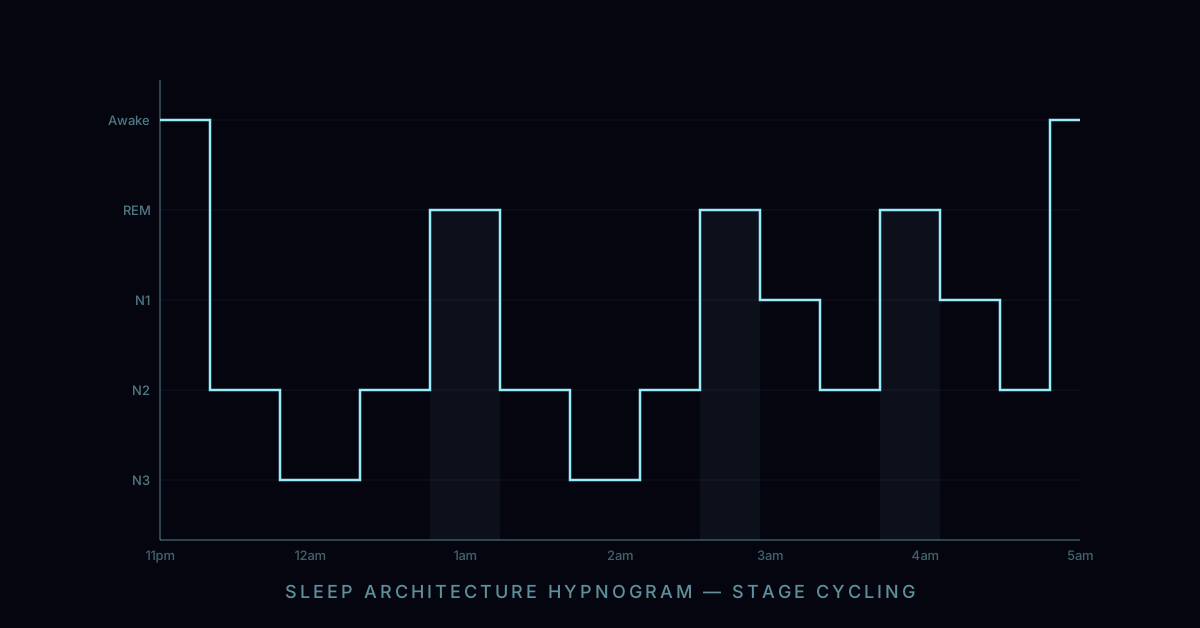
The Gold Standard: What Sleep Trackers Are Measured Against
To evaluate any sleep tracking technology, we must begin with the gold standard it is compared against: polysomnography (PSG). A full sleep lab PSG simultaneously records electroencephalography (EEG — multiple electrode channels capturing brain electrical activity), electrooculography (EOG — eye movements), chin electromyography (EMG — muscle tone for REM atonia detection), respiratory effort belts, nasal airflow, SpO2, ECG, and leg movement sensors. A trained sleep technologist scores each 30-second epoch (a "page") of this multi-channel recording according to standardized AASM criteria, assigning it one of five stages: Wake, N1, N2, N3, or REM.
PSG can detect sleep stages with approximately 92–97% inter-scorer reliability when performed by trained technologists using standard AASM criteria. This is the benchmark. Consumer trackers, using only 1–4 sensors measuring indirect physiological proxies, must achieve the best approximation of this multi-channel ground truth from far less data.
How Consumer Sleep Trackers Work
Consumer sleep trackers use three primary sensor modalities to infer sleep architecture:
Photoplethysmography (PPG): LEDs (typically green at 530nm for sleep, red/infrared for SpO2) shine into the skin surface. A photodetector measures the variation in light absorption as blood volume pulses with each heartbeat. From the PPG waveform, algorithms extract: heart rate (HR), beat-to-beat heart rate variability (HRV), pulse wave velocity (a proxy for arterial stiffness and vascular tone), and respiratory-induced signal variation. Each sleep stage produces a characteristic HR and HRV profile that forms the basis for staging.
Accelerometry: Three-axis MEMS accelerometers detect body movement. Movement is highest during N1 and wake, minimal during N3, and near-zero during REM (due to muscle atonia). The combination of movement absence with the REM-characteristic irregular HR pattern is the key signal for REM stage detection.
Skin Temperature: Thermistors or infrared sensors measure distal skin temperature (wrist or finger). Core body temperature follows a circadian rhythm that influences sleep stages — temperature drops at sleep onset, reaches its nadir in the first half of the night during deep sleep, and rises toward morning natural waking. Devices including the Oura Ring 4 and WHOOP 5 incorporate temperature sensing as a fourth signal to improve staging accuracy.
The Systematic Review Evidence: What Studies Actually Show
The most comprehensive independent assessment of consumer sleep tracker accuracy against PSG was the systematic review by de Zambotti and colleagues at SRI International, published in Sleep Medicine Reviews (2019). Analyzing 10 published validation studies across multiple consumer devices, the review found consistent patterns across all tested wearables:
- Total sleep time was overestimated by an average of 35–60 minutes across devices (trackers tend to classify brief arousals and light waking as light sleep)
- Sleep efficiency was similarly overestimated (by 5–15 percentage points)
- Wake after sleep onset (WASO) was consistently underestimated — devices miss nocturnal awakenings, particularly brief ones under 5 minutes
- N3 deep sleep was consistently the least accurately detected stage across all devices — sensitivity for N3 ranged from 37–62% in validation studies
- N2 sleep was the most robustly detected stage (it is the dominant stage, making classification easier)
- REM sleep showed moderate detection accuracy, better than N3 but worse than N2
These patterns have a consistent mechanistic explanation: consumer wearables rely primarily on actigraphy (movement detection) and photoplethysmography, neither of which can directly detect the EEG signatures that define sleep stages in PSG. The overestimation of total sleep time reflects the tendency of PPG-based algorithms to classify brief arousals and low-movement wakefulness as light sleep — a systematic bias rather than random error. A subsequent validation study by Kahawage et al. (2020, Frontiers in Sleep Medicine) confirmed these overestimation patterns in free-living conditions rather than controlled lab settings, finding that the real-world accuracy gap was at least as large as lab studies suggested. In practical terms, if your wearable reports 7 hours 30 minutes of sleep, the PSG-equivalent figure is likely closer to 6 hours 45 minutes to 7 hours — a meaningful difference when evaluating whether you are meeting recommended sleep targets.
Device-by-Device Accuracy Assessment: 2026
The figures in the table below should be read as indicative benchmarks rather than a strict ranking. Overall accuracy percentages derive from different validation methods: Oura Ring validations tend to use well-controlled lab protocols with simultaneous PSG recordings, while Apple Watch and Garmin accuracy figures often come from manufacturer-funded studies or studies with smaller participant samples — differences in methodology make direct percentage comparisons unreliable. The under-mattress Withings Sleep Analyzer shows a distinct performance profile because radar and ballistocardiography detect respiratory signals directly rather than inferring them from wrist motion or photoplethysmography; this gives it strong performance for sleep/wake detection and respiration-based metrics but weaker performance for fine-grained NREM staging that requires EEG-level signal quality. Across all devices, a foundational limitation applies: no consumer sleep tracker has been validated in a large, pre-registered independent PSG study — the absence of this gold-standard evidence limits confident device ranking and means published accuracy figures should be interpreted with caution.
| Device | Form Factor | Best Performance Domain | Weakest Domain | Overall Stage Accuracy (approx.) |
|---|---|---|---|---|
| Oura Ring 4 | Finger ring | Total sleep time, HRV, N2 | N3 precision, N1 | ~78% (vs. PSG, Oura 3 data) |
| WHOOP 5 | Wrist band | REM detection, HRV accuracy | N3 vs. N2 discrimination | ~72–75% (internal data) |
| Apple Watch S10 | Wrist watch | Total sleep time, Sleep onset | N3 detection, brief awakenings | ~70–73% (published validations) |
| Garmin (Epix/Fenix) | Wrist watch | Total sleep time, movement detection | N3 staging, REM quantification | ~68–72% (published validations) |
| Withings Sleep Analyzer | Under-mattress | Respiratory events, N3 detection | N1 staging, motion artifact | ~82% for sleep/wake; ~65% staging |
The accuracy figures in this table should inform purchase decisions at the category level rather than inspiring fine-grained comparisons between similar devices. The Oura Ring's advantage over wrist-based PPG devices reflects the anatomical superiority of the finger as a PPG site, not superior algorithms — a well-designed wrist device with Oura's processing would still underperform a finger-based device. Within the wrist category, WHOOP and Garmin Fenix 7 perform comparably because they share similar hardware limitations. The under-mattress category (Withings) offers a distinct value proposition: no wearable required, making it suitable for people who cannot tolerate wearing devices during sleep. No single device is the right choice for all users — the decision should be driven by primary use case (sleep staging accuracy vs. activity integration vs. medical-grade ECG) and form factor preference.
Why Finger Rings Outperform Wrist Devices for Sleep Staging
The anatomical superiority of the finger as a PPG measurement site is well-established in clinical literature. The finger has: thinner overlying skin and subcutaneous tissue (less optical path length), higher capillary density, better perfusion (unlike the wrist, the digital arteries provide robust pulsatile flow at rest), and substantially less motion artifact during sleep (the finger moves far less than the wrist during position changes and respiration).
The Oura Ring's validated advantage over wrist devices for sleep metrics is consistently explained by this physiological superior signal quality. HRV measurements from a ring are typically more accurate and less noisy than wrist measurements — a clinically important difference since HRV is the primary substrate from which sleep stage inferences are made. The practical tradeoff is that rings cannot display screens or respond to taps, limiting their functionality to health tracking rather than general smartwatch utility.
EEG Consumer Headbands: The Most Accurate Consumer Option
For consumers who want PSG-level sleep stage accuracy without a sleep lab visit, EEG-based consumer headbands represent the only current option. The Dreem headband, developed by the French neurotechnology company Dreem (later Beacon Biosignals), was validated extensively against PSG and demonstrated stage-by-stage agreement of approximately 88–91% — far superior to all PPG-based wearables. However, Dreem discontinued its consumer product in 2023 and pivoted to pharmaceutical clinical trial use. The MUSE headband (InteraXon) provides EEG-based sleep analysis and has published validation data showing strong N3 detection accuracy, but its clinical adoption remains limited. As of 2026, the combination of comfort limitations (wearing an EEG headband for 7–8 hours) and limited availability means the practical market is still dominated by PPG-based devices despite their accuracy limitations.
For individuals who genuinely need accurate sleep staging — those with suspected sleep disorders, treatment-resistant insomnia, or unusual fatigue despite adequate tracked sleep time — the practical recommendation remains a referral to a sleep medicine specialist for formal polysomnography or ambulatory PSG. Single-night in-lab PSG typically costs £500–1,200 in the UK and $1,500–3,000 in the US, but split-night protocols (diagnostic plus CPAP titration in one study) and home sleep apnea tests (HSATs) provide more accessible options for specific presentations. Consumer EEG headbands remain a promising category, but the Dreem discontinuation illustrates the fragility of this market segment — accurate data is only valuable if the device remains commercially supported long enough to establish longitudinal baselines.
What Sleep Trackers Are Genuinely Useful For
Despite the accuracy limitations for absolute sleep staging, consumer sleep trackers provide genuine, clinically meaningful value in several domains:
- Sleep timing and consistency: Trackers are highly accurate for detecting when you fell asleep and when you woke up. Sleep timing variability (a measure of circadian regularity) is strongly predictive of metabolic health and is well-captured by all wearables.
- Total sleep time trends: Even with a 30–45 minute overestimate bias, trends in total sleep time are reliably captured. If your tracker shows a consistent decrease in sleep time over a two-week period, that directional signal is accurate.
- HRV and overnight recovery: Finger-ring based HRV (Oura) and wrist-based HRV (WHOOP, Garmin) are reasonably well-validated for their physiological HRV metrics, if not for the sleep stage inferences derived from them. HRV trends are among the most useful health monitoring data points a wearable provides.
- Lifestyle intervention response: Tracking how specific behaviors (alcohol, exercise, temperature, late eating, stress) affect your sleep metrics over time provides actionable information even if the absolute stage numbers are imprecise.
- Respiratory screening: Devices with SpO2 sensing (Apple Watch, Garmin, Withings) can screen for potential sleep-disordered breathing — detecting episodic SpO2 desaturations that may warrant formal sleep apnea evaluation. This is arguably the most high-value health screening function of consumer sleep tracking.
Of these five use cases, respiratory screening and HRV trend monitoring carry the highest clinical significance for long-term health. Sleep apnea affects approximately 15–20% of adults and remains substantially underdiagnosed; a wearable that consistently flags nocturnal SpO2 dips below 90% provides genuinely actionable information that warrants clinical follow-up, regardless of the device's limitations in sleep staging. For all other use cases, the key principle is to interpret tracker data as directional trend information rather than precise absolute values — a tracker that reliably shows you sleeping better on days when you exercise and worse on nights with alcohol consumption is giving you useful signal even if its stage percentages are off by a meaningful margin.
The Orthosomnia Problem: When Tracking Becomes Counterproductive
The AASM's 2018 position paper on consumer sleep technologies introduced the term "orthosomnia" — an anxiety about achieving perfect tracker-reported sleep metrics that paradoxically worsens sleep quality. The irony of sleep tracking is that the increased cognitive arousal from checking and analyzing sleep data can itself increase pre-sleep worry and sleep-onset insomnia.
Sleep clinicians have reported patients arriving in clinic distressed about their Oura Ring's report of only 45 minutes of deep sleep — a reading that may reflect accurate below-normal deep sleep, or may simply reflect the tracker's consistent underestimation of N3 in someone who actually has 75 minutes. The practical guidance: check your tracker weekly rather than nightly for trend analysis; resist the urge to "optimize" individual nights; use tracker data as one signal among many, weighed alongside subjective wellbeing, daytime energy, and cognitive performance.